
 |
| ⵣ (yaz) Amazigh (Berber) symbol of freedom painted on a wall |
From the medina of Marrakech, after our Marrakech stay, we turned southeast for a full road day across the High Atlas to Ouarzazate. Our shared van would climb N9 over Tizi n’Tichka, stop at Aït Benhaddou, pass the Noor solar complex and Ouarzazate’s film studios, and finally deposit us at a hotel east of town. Morocco had apparently decided one theme per day was inefficient.
This post covers only the Marrakech-to-Ouarzazate leg of our 2023 Morocco journey. The complete route is on our full Morocco expedition map; later posts continue toward the Sahara and, eventually, Fes.
Marrakech to Ouarzazate — Post Summary
This road day crosses the High Atlas from Marrakech to Ouarzazate by shared van, with stops at Tizi n’Tichka, Aït Benhaddou, the Noor Ouarzazate Solar Complex and the film studios at the center of Ouarzazate’s movie-production industry. Along the way are Amazigh symbols, roadside cooperatives, a very good lunch, earthen architecture, movie sets and one much-appreciated ice cream.
| What's Covered | |
| 🏔️ | High Atlas and Amazigh country |
| 🚐 | Marrakech to Tizi n’Tichka on N9 |
| ☕ | High Atlas descent, cooperatives and Agouim lunch |
| 🏰 | Aït Benhaddou earthen ksar and caravan-route history |
| 🎬 | Aït Benhaddou film locations |
| ☀️ | Noor Ouarzazate Solar Complex |
| 🎥 | Atlas and CLA film studios |
| 🛏️ | Hotel Ksar Kaissar overnight |
On July 13, 2023, we left Marrakech in a shared Mercedes van and followed N9 into the High Atlas toward Ouarzazate. The road climbed through Toufliht to Tizi n’Tichka, dropped toward Agouim and Aït Benhaddou, then carried us past the Noor Ouarzazate Solar Complex and Ouarzazate’s film studios before our overnight stop at Hotel Ksar Kaissar in Tazzakht. One road day, several versions of Morocco, and enough hairpins to keep the van professionally employed.
Method: Shared Mercedes passenger van on N9
Time: 7:30 AM pickup to about 8 PM hotel arrival, with stops
Themes: High Atlas · Amazigh country · earthen heritage · solar power · cinema
Route at a Glance
- High Atlas and Amazigh country — the mountain setting behind the road.
- Marrakech departure — early Jemaa el-Fna and the N9 climb.
- Tizi n’Tichka — the High Atlas pass and its road viewpoints.
- Ighrem N’Ougdal and Agouim — descent, cooperatives and lunch.
- Aït Benhaddou — UNESCO earthen heritage and older caravan-route history.
- Aït Benhaddou on screen — international film locations and sets.
- Noor Ouarzazate Solar Complex — concentrated solar power outside town.
- Ouarzazate film studios — Atlas, CLA and roadside sets.
- Hotel Ksar Kaissar — our overnight stop in Tazzakht.
High Atlas and Amazigh Country
The Atlas system stretches across northwestern Africa, with Morocco containing the Anti-Atlas, High Atlas and Middle Atlas ranges; the Rif lies farther north near the Strait of Gibraltar. This map of the Atlas ranges gives the broad geography. Our road day crossed the High Atlas. Later in the Morocco journey, the route toward Fes would meet the Middle Atlas.
 |
Middle, High and Anti-Atlas Mountain Ranges |
The human geography matters just as much. Amazigh communities are indigenous to North Africa, and Tamazight is one of Morocco’s official languages. We saw the Amazigh flag repeatedly during this journey. Its central ⵣ character, often called yaz, is widely used as an Amazigh identity symbol; the flag’s blue, green and yellow bands are commonly associated with sea, mountains and desert.
 |
| Amazigh flag |
The word “Berber” still appears widely in travel material, but many people prefer Amazigh or the plural Imazighen. On the road we met people who identified themselves as Amazigh, and we saw the same symbols from Sti Fadma onward. Tuareg communities belong to the wider Amazigh world, but the Sahara is home to many peoples, and not every Tuareg lives a nomadic life. Deserts, like humans, tend to resist tidy filing systems.
Marrakech to Tizi n’Tichka on N9
We had a quick breakfast, checked out of our riad near Jemaa el-Fna by 7 AM, and walked a couple of blocks to Hôtel Restaurant Café de France. The square was still asleep, which was almost suspicious after seeing what it could do after dark.
 |
| Quiet Jemaa el-Fna square in Marrakech Medina early in the morning |
Yassine of Morocco Global Adventures picked us up at 7:30 AM in a Mercedes passenger van. Soon we were heading east on N9, trading the close-packed medina for a road that aimed directly at the mountains.
 |
| Inside our van |
At about 9:10 AM we passed Cooperative Arije Al Ghaba, selling argan oil and herbal products and also offering a café, restaurant and bathrooms. Road-trip infrastructure takes many forms; bathrooms remain one of the more persuasive.
 |
| Arije Al Ghaba argan oil and herbal medicines cooperative |
The road kept gaining height and the High Atlas filled more of the view. Villages clung to the valleys while bare slopes rose around them, and the urban morning behind us became increasingly theoretical.
 |
| High Atlas Mountains |
Around 9:30 AM we stopped at Café Restaurant Tafraout near Toufliht for coffee and snacks. It had a convenience store, souvenir shop, café and restaurant, plus outdoor seating looking toward the mountains.
 |
| Café Restaurant Tafraout near Toufliht, our 9:30 AM coffee stop on the climb into the High Atlas. |
The stop was large enough to handle the steady tourist traffic on N9, but the terrace still gave us a quiet look at the road climbing away from Marrakech.
 |
| Another view of Café Restaurant Tafraout, a full-service roadside stop on N9 near Toufliht. |
Toufliht sits on the approach to the higher part of the pass road. From here the bends tightened, the rock became more exposed, and the van began doing what mountain vans do best: turning steering-wheel movement into scenery.
 |
 |
 |
 |
| Café Restaurant Tafraout at Toufliht on N9, our morning stop as the road climbed into the High Atlas. | |||
Shortly before 11 AM we reached one of the main viewpoints around Tizi n’Tichka. The pass is about 2,250 meters above sea level, with a broad view back across the road’s switchbacks and surrounding High Atlas ridges.
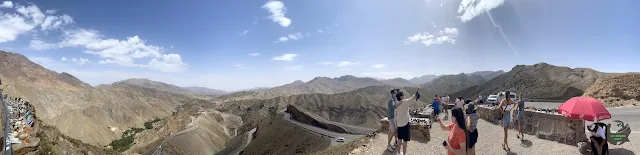 |
| Looking across the N9 switchbacks from the Tizi n’Tichka viewpoint in the High Atlas. |
The modern N9 crossing is a motor-road corridor through the High Atlas. Older commercial movement through this region followed different routes and passes; Aït Benhaddou’s historic connection toward Marrakech is associated with the Drâa Valley and Tizi n’Telouet.
 |
 |
| Tizi n’Tichka from N9, where the road crests the High Atlas before dropping toward Ouarzazate. | |
A lion shot near Tizi n’Tichka in 1942 is often cited as Morocco’s last wild Barbary lion. Later evidence suggests wild lions survived longer in Algeria, perhaps into the late 1950s. Even extinction dates, inconveniently, dislike neat signposts.
 |
| Tizi n'Tichka pass, Atlas Mountains |
Down the High Atlas to Agouim
East of the pass, N9 dropped through a drier side of the mountains toward Melladi and Ighrem N’Ougdal. The country looked rugged and sparse, and several roadside businesses appeared shuttered. We could see the closed doors; assigning a grand theory to them would have required considerably more paperwork.
 |
 |
 |
 |
| The N9 descent through Melladi and Ighrem N’Ougdal, moving from bare High Atlas slopes toward Agouim. | |||
At about 11:30 AM we stopped at a roadside plaza near Melladi for coffee and a bathroom break. Restaurant Palais de Tichka was the most obvious building in the cluster.
 |
| Restaurant Palais de Tichka at our Melladi roadside stop, beside the Ait Tamnat women’s argan cooperative. |
Beside it was Coopérative Féminine d’argan Ait Tamnat, a women’s cooperative selling argan oil and a range of herbal extracts, oils, perfumes, cosmetics and related products.
 |
| A street dog sleeps in front of Restaurant Palais de Tichka |
The shade in front of the restaurant clearly had at least one satisfied customer. Its commitment to doing absolutely nothing was beyond dispute.
 |
| Ighil |
We continued through the small settlement of Ighil as the road eased lower. The High Atlas was still all around us, but the harsher pass country was giving way to broader valleys.
 |
| Agouim |
By noon we were on the outskirts of Agouim and ready for lunch. The rest of our group chose Hotel Restaurant L’Oasis D’or Ait Ben Haddou. We walked two buildings farther to the smaller Snack Restaurant Zaytoune, which looked less polished and, more important at that moment, had food.
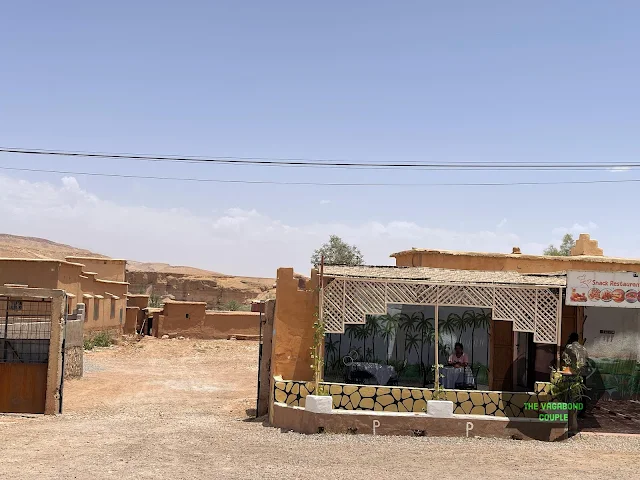 |
| Snack Restaurant Zaytoune in Agouim, our smaller lunch stop after the High Atlas crossing. |
There was no air conditioning, but the fan-cooled porch was comfortable. We were the only customers and received cheerful personal attention and a good conversation with the owner.
 |
| The fan-cooled porch at Restaurant Zaytoune, a welcome break from the midday heat. |
The tagine and couscous were excellent. The three-course meal cost about US$13, the same flat-price arrangement we had seen in Marrakech: choose a starter, main course and dessert and let appetite handle the accounting.
 |
| Restaurant Zaytoune at lunchtime, quiet enough for a long conversation with the owner. |
After the mountain morning, sitting under a fan with a full plate felt like a fairly advanced transport technology.
 |
| Restaurant Zaytoune |
Aït Benhaddou: Earthen Ksar on a Caravan Route
We reached Aït Benhaddou at about 2:30 PM. The UNESCO-listed Ksar of Aït Benhaddou stands in the Ounila Valley as a fortified earthen settlement. A kasbah can refer to a fortified residence or citadel in North African usage; a ksar is a fortified settlement. Here, “ksar” is the useful word for the whole village.
 |
| The fortified ksar of Aït Benhaddou |
UNESCO says the oldest existing constructions at Aït Benhaddou do not appear to be earlier than the 17th century, though the building methods and settlement pattern are older. History had already supplied plenty; there was no need to give it bonus centuries.
 |
| Ksar of Aït Benhaddou |
Aït Benhaddou lay on an old commercial route linking the ancient Sudan with Marrakech through the Drâa Valley and Tizi n’Telouet. That older corridor is distinct from the modern N9 route over Tizi n’Tichka that brought us here.
 |
| Pedestrian bridge to the Ksar of Aït Benhaddou |
A pedestrian bridge now crosses the Ounila River between the newer village and the historic ksar. During our visit, some families still lived within the old settlement, while the newer village stood across the water.
 |
| Inside the Ksar of Aït Benhaddou |
Inside, narrow lanes and stairs pass between defensive walls, corner towers and earthen houses. UNESCO also records community spaces including a mosque, public square, areas outside the walls and a caravanserai.
 |
 |
| Inside Aït Benhaddou, where narrow passages thread between earthen walls and towers. | |
The construction uses the pre-Saharan earthen tradition of earth and wood, with techniques that include rammed earth and earthen brick. The material looks simple because dirt is famously available; keeping large buildings standing in it for centuries is the less simple part.
 |
 |
 |
| Views from the upper parts of Aït Benhaddou across the Ounila River and newer village. | ||
From the higher parts of the ksar we could look across the river toward the newer village and the dry Ounila Valley. From below, those same upper walls and towers had looked almost vertical; from here, the river and modern settlement spread out beneath them.
Aït Benhaddou on Screen
Aït Benhaddou has also spent decades pretending to be somewhere else. Its earthen walls and the nearby purpose-built sets have appeared in many international film and television productions, including Game of Thrones and several large historical films. Gift shops make sure nobody forgets this secondary career.
 |
| The film list on a gift-shop wall at Aït Benhaddou, evidence of the ksar’s very busy screen career. |
One wall displayed a long list of productions filmed in or around the ksar. The list is useful evidence of how often the place has been recycled by cameras, usually without asking the village to change its architectural wardrobe.
 |
| List of Films shot at Aït Benhaddou |
Ridley Scott’s Gladiator (2000) is one of the productions filmed here. A purpose-built Gladiator set was visible during our 2023 visit to Aït Benhaddou.
The Gladiator film set in Ait Benhaddou, Ouarzazate, 1999.
by u/Eddiien in Morocco
The old Reddit post above shows the Gladiator set in 1999, before the film reached theaters. It also gives a useful reminder that a “historic-looking” wall in Ouarzazate country may have been built for a call sheet rather than a sultan.
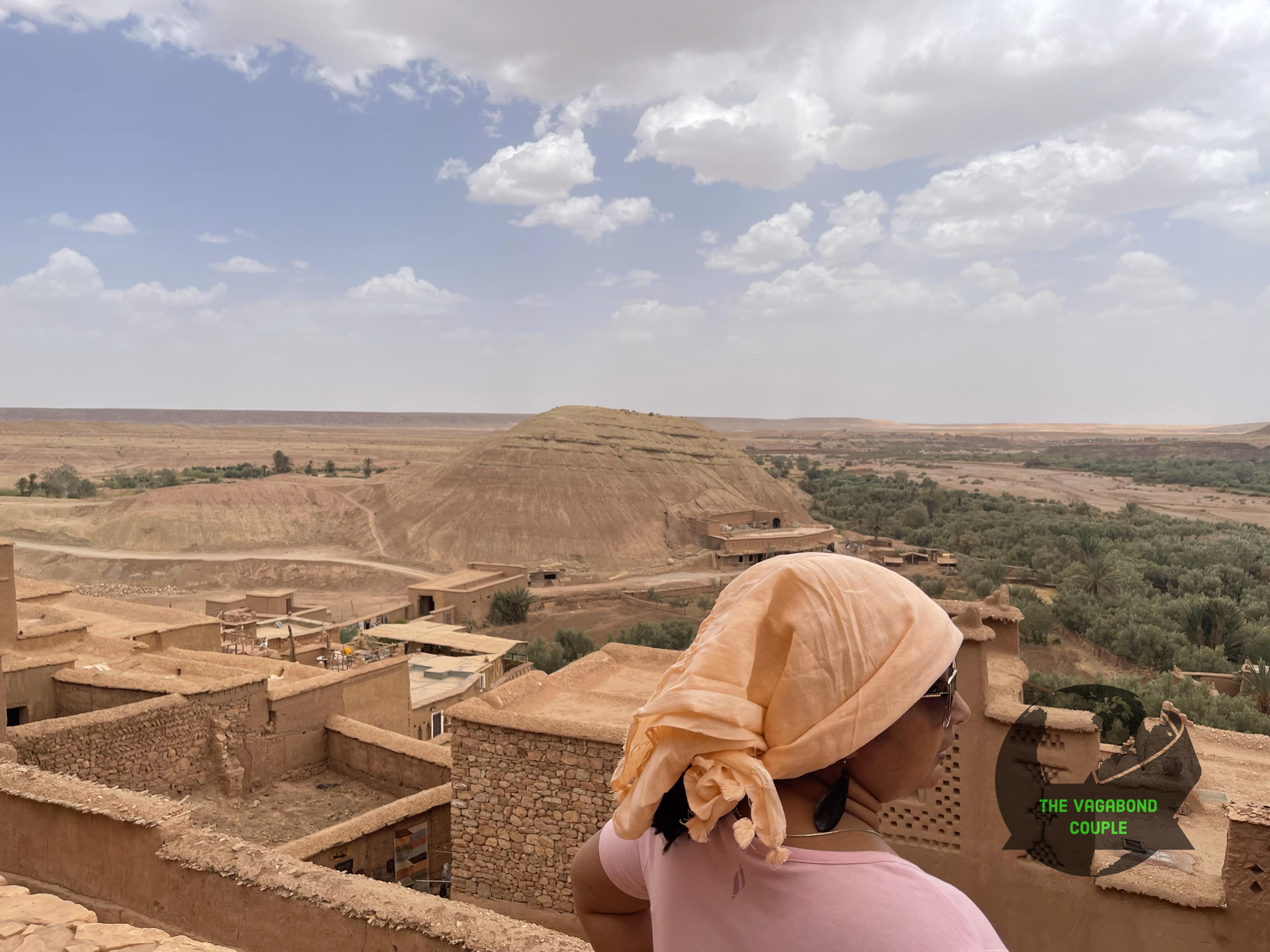 |
| Aït Benhaddou film set used for Gladiator (2000) |
Real earthen architecture and purpose-built movie structures can sit surprisingly close together here, which makes keeping the two straight rather useful.
Video: Gladiator film set at Aït Benhaddou, Morocco.
By then the afternoon heat had made a persuasive argument for ice cream. The gift shop had some, which may be the least historically significant detail in this post and one of the most immediately useful.
 |
| Ait Ben-Haddou gift store |
Noor Ouarzazate Solar Complex
About six miles from Ouarzazate, the Noor Ouarzazate Solar Complex came into view. The Masen page for the first Noor Ouarzazate CSP plant covers that initial project; the three CSP plants together total about 510 MW, while the separate fourth plant adds 72 MW of photovoltaic capacity.
 |
| Ouarzazate / Noor Complex Solar Power Station |
The concentrated-solar plants use mirrors to focus solar energy onto a heat-transfer system. That heat is used to produce steam for turbines, while molten-salt storage can hold thermal energy for generation after the strongest sunlight has faded. No elevated reservoir of hot water is required to perform magic above the desert.
 |
| Noor Complex Solar Power Plant |
From the road, the scale is easier to grasp than the engineering. Towers, mirror fields and transmission infrastructure spread across the dry country outside Ouarzazate, turning intense sun into something more commercially useful than complaints.
 |
| Ouarzazate / Noor Complex Solar Power Station |
Ouarzazate Film Studios: Atlas and CLA
It was almost 4 PM when the studio side of Ouarzazate took over. Atlas Studios and CLA Studios are part of the city’s long-running film-production industry, and the roads around them are dotted with sets, façades and structures built to impersonate other centuries and countries.
 |
| Movie sets sprawling around deserts of Ouarzazate |
CLA Studios sits directly along N9, so some of the film infrastructure is visible without leaving the highway. We saw studio entrances and sets as our van moved through the outskirts.
 |
| CLA Cinematographic Studios, Ouarzazate |
Among the recognizable constructions was a set associated with Kingdom of Heaven (2005). From the van window we could see dry open ground around the studios and large purpose-built structures standing beyond the road.
 |
| Movie Set of Kingdom of Heaven (2005) |
Other sets recreated ancient Egyptian architecture on a scale that is hard to miss. The result is an entertaining collision of Morocco, pharaonic Egypt and modern production logistics, all within the same patch of dust.
 |
 |
| Egyptian-style film sets around Ouarzazate, part of the studio-built worlds spread across the dry outskirts. | |
We did not have time to take a studio tour, so our view remained the road-trip version: gates, exterior sets and glimpses from outside. That was enough to see the studio infrastructure surrounding Ouarzazate.
 |
| Movie sets at Ouarzazate |
Oscar Hotel stands within the Atlas Studios complex and has long served the film-production world as well as other guests. We passed it rather than checking in; our own bed was still several hours farther along the day.
 |
 |
| Oscar Hotel at Atlas Studios in Ouarzazate, beside the production complex. | |
Hotel Ksar Kaissar
At about 8 PM we finally reached Hotel Ksar Kaissar in Tazzakht, a few miles east of central Ouarzazate. After a day of mountain passes, earthen fortifications, solar towers and movie Egypt, a reception desk felt almost radically ordinary.
 |
| A plate of dried roses at the reception |
That small decorative detail fit a hotel that was beautifully built and furnished.
 |
 |
 |
 |
 |
 |
 |
|
| Hotel Ksar Kaissar in Tazzakht, our overnight stop east of central Ouarzazate. | |||
Dinner was on the open terrace of the adjacent dining hall, and it was excellent. The following morning we would be up early again for Tinghir and the Todgha Valley, a farm visit and Amazigh rug workshop, Todra Gorge, Tinejdad, Ksar Touroug and Erfoud before continuing to Merzouga for the dromedary ride and desert camp at Erg Chebbi.
This day was a compact preview of why the Morocco route kept changing character so quickly: Marrakech’s medina behind us, High Atlas switchbacks overhead, old earthen trade-route architecture at Aït Benhaddou, then solar engineering and cinema on the approach to Ouarzazate. Next came the desert leg: Ouarzazate through Tinghir and Todra Gorge to Merzouga and Erg Chebbi.
