
 |
| Riding toward Boquillas del Carmen after crossing the Rio Grande from Big Bend National Park. |
Roswell had given us UFO museums, alien burgers and Zog, the small gray souvenir passenger from Part 17: Durango to Roswell. By morning, the saucers stayed behind while Shehzadi, our overlanding Toyota Tundra, pointed south on US-285.
This leg carried us into Far West Texas: Pecos for cowboy folklore and rodeo history, Terlingua Ranch for a cabin beneath the Christmas Mountains, Big Bend National Park for desert geology, and the Boquillas Crossing for a rowboat-and-mule hop into Mexico. Texas had apparently decided one border was not enough scenery.
Trans-America Overland Part 18: Roswell to Terlingua Ranch via Pecos, Big Bend and Boquillas — Post Summary
This part follows us from Roswell down US-285 to Pecos, then west and south to Terlingua Ranch, Big Bend National Park and the Boquillas Crossing. Along the way, we meet Pecos Bill folklore, sleep in a mountain cabin, drive through the Chihuahuan Desert, cross the Rio Grande by rowboat and ride into Boquillas del Carmen before returning to Terlingua Ranch.
| What's Covered | |
| 🤠 | Pecos — Pecos Bill folklore, giant cowboy boots and rodeo history |
| 🏡 | Terlingua Ranch — gravel roads, a rustic cabin and Christmas Mountains country |
| 🏜️ | Big Bend National Park — Chisos clouds, ancient-sea geology and desert plants |
| 🚣 | Boquillas Crossing — Rio Grande rowboat, mule ride and lunch in Mexico |
| 🛻 | Return to Terlingua Ranch — Big Bend drive, cabin night and dashcam video |
| ➡️ | Next Stop — Terlingua Ranch to San Antonio in Part 19 |
We drove from Roswell to Terlingua Ranch via US-285, Pecos, US-67 and TX-118, then used the ranch as our base for Big Bend National Park and the Boquillas Crossing into Mexico. This stretch traded alien souvenirs for cowboy folklore, desert geology and a border crossed by rowboat. It also proved that Shehzadi could collect dust in two countries before dinner.
Method: Overland by truck, then rowboat and mule across the border
Distance / Time: Multi-stop road leg / one overnight at Terlingua Ranch
Themes: Pecos Bill folklore · rodeo history · Chihuahuan Desert geology · Rio Grande border crossing
Vehicle: Shehzadi (2024 Toyota Tundra)
Route at a Glance
- Roswell to Pecos — US-285 into Far West Texas
- Pecos museum district — Pecos Bill, giant boots and rodeo history
- Pecos to Terlingua Ranch — US-67 and TX-118 into Christmas Mountains country
- Big Bend National Park — Chisos clouds, desert plants and ancient-sea geology
- Boquillas Crossing — rowboat across the Rio Grande and mule ride into Boquillas del Carmen
- Boquillas to Terlingua Ranch — return through Big Bend before the eastbound leg
Pecos: Pecos Bill, Giant Boots and Rodeo History
Pecos was lunch with a side of frontier mythology. Outside the West of the Pecos Museum, giant painted cowboy boots rose beside the old museum buildings, while a nearby monument showed Pecos Bill grappling with an oversized snake. The sculptures were real. Pecos Bill was considerably less burdened by that requirement.

|

|

|

|
| Pecos museum district: giant painted boots, the Pecos Bill snake statue, and the West of the Pecos Museum. The boots are public art; Pecos Bill remains safely fictional. | |||
Pecos Bill belongs to American tall-tale literature, though scholars disagree over how much came from oral tradition. The University of Nebraska's Encyclopedia of the Great Plains notes that writer Edward O'Reilly once admitted inventing the character. Either way, rattlesnake lassos, panther rides and cyclone taming remain excellent stories and terrible insurance claims.
Pecos also keeps a serious rodeo claim. The local rodeo organization dates its first cowboy contest to July 4, 1883. The Texas State Historical Association lists Pecos among the earliest rodeos on record, while the ProRodeo Hall of Fame notes competing first-rodeo claims from Santa Fe, Deer Trail and Pecos. History becomes less argumentative when nobody uses the word first.
Inside the Texas Rodeo Hall of Fame and museum district, photographs and memorabilia carried the story from ranch work into organized competition. Then came fajitas at a roadside diner. Texas portion sizes remained historically unconcerned with restraint.
Terlingua Ranch in the Christmas Mountains
From Pecos, US-67 carried us west before TX-118 turned south toward Terlingua Ranch. The final ranch road turned to gravel, where a skeleton prop sat on a rusted tractor and watched Shehzadi approach. It had been waiting so long that customer service seemed pointless.
 |
| A skeleton prop on a rusted tractor beside Shehzadi on the road to Terlingua Ranch. The driver had missed several meal breaks. |
Our cabin stood among rough ridges with the ranch cafe close enough to rescue us from the advanced survival exercise known as arriving just before closing. Jackrabbits moved around the ranch while we unloaded and watched the rocks darken around the cabin.
 |
| Shehzadi parked beside our rustic cabin at Terlingua Ranch. |
The Christmas Mountains rose around our ranch base; the Chisos Mountains waited inside the national park to the south. The wider Big Bend region carries a much older human record. NPS archaeology documents about 10,000 years of Native occupation. Spanish mission accounts used the name Chizo for bands living in the high mountains, and the Chisos Mountains carry that name. Mescalero Apache and later Comanche presence followed. Ten thousand years was already enough history for one sunset.
 |
| Cabins, desert ridges and mountains spread across the Terlingua Ranch panorama. |
By evening, the ridges turned red-orange. We reached the cafe before closing, ordered the chicken and pie, and returned to the cabin with the useful knowledge that pecans can solve problems geology cannot.
Big Bend National Park: Desert Roads and Chisos Clouds
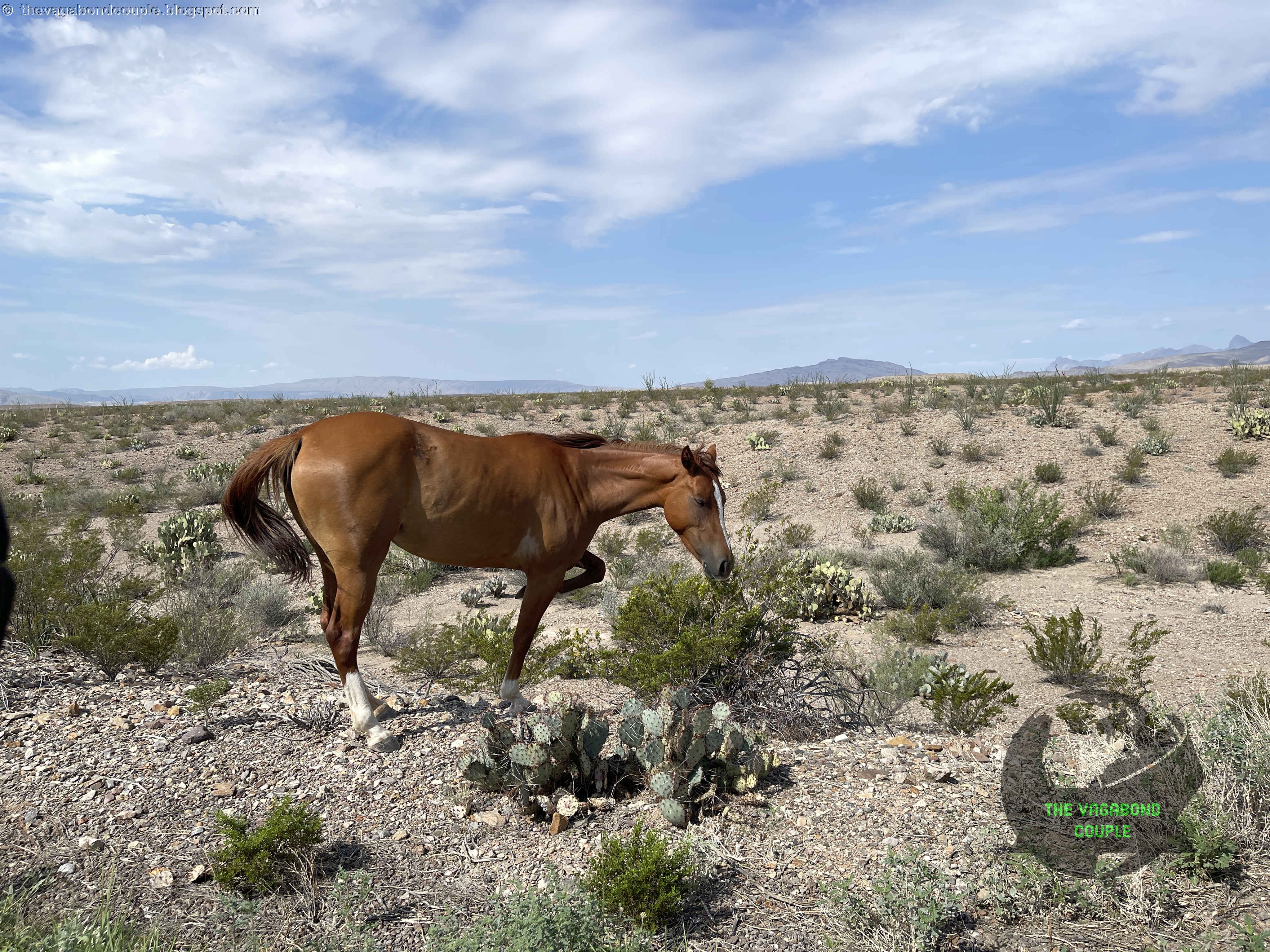
Morning clouds spilled over the Chisos Mountains as we entered Big Bend National Park. Shehzadi parked beneath ridges that had been visible for miles. A horse stood on the desert floor, and javelinas moved through creosote. We did not interview either species, which seemed wise.

|

|
|
| Big Bend arrival: the park entrance, Shehzadi beneath the mountains, and a horse in the open desert. | ||
Big Bend's geology refuses to fit one tidy origin story. NPS describes ancient seas, folding, faulting, volcanoes and erosion, while the USGS map separates marine limestone, volcanic formations and structural features across the park. Volcanic rocks dominate the Chisos Mountains; marine and continental deposits appear elsewhere. Rocks, like committees, become difficult when forced into one agenda.
 |
| The Ancient Ocean interpretive panel explains Big Bend's Cretaceous marine past. |
Ancient Seas, Prickly Pear and Ocotillo
The Ancient Ocean panel beside the road put the marine chapter in plain view. Cretaceous seas covered this region, and later uplift and erosion exposed marine sediments and fossils. Big Bend preserves a long geologic record with several chapters stacked on top of each other.

|

|

|

|

|

|
||
| Big Bend's desert road: Shehzadi, clouded mountains, prickly pear, leafy ocotillo, eroded badlands and open Chihuahuan Desert views. | |||
The paddled cactus in our photograph was a prickly pear, not a beavertail. Prickly pears carry tiny barbed glochids that can look soft until they meet skin and begin a long administrative process. Their fruit is called tuna, and the pads are nopales.
The ocotillo in our photograph wore a fresh set of leaves. Ocotillos can leaf out after rain, drop those leaves as the soil dries, and repeat the cycle several times a year. Red flowers usually appear in spring. Our plant had leaves, no flowers, and no interest in matching a tourist brochure.
We continued through open Chihuahuan Desert country beneath clouded ridges, with badlands and mountain views changing around the road. The Rio Grande lay ahead at Boquillas Crossing.
Boquillas Crossing: Rowboat and Mule into Mexico
At the Boquillas Port of Entry, the road ended at a border with no bridge. NPS identifies it as the only legal crossing inside Big Bend National Park. A valid passport is required. Beyond the formalities, we walked down to the Rio Grande, where a small rowboat handled the international transport department.

|

|
| Boquillas Port of Entry and the welcome mural on the U.S. side of the Rio Grande. | |
A detailed NPS sign explained the historic crossing and the process for returning to the United States.
 |
| National Park Service instructions for the historic Boquillas river crossing. |
The river was low enough for our boatman to step into the water, roll up his jeans and pull the boat across. He made international navigation look like a laundry problem.
 |
| Our rowboat on the Rio Grande between Big Bend National Park and Boquillas del Carmen. |
On the Mexican bank, a sign placed Boquillas del Carmen 0.65 mile away. Pickup trucks and animal handlers waited nearby. We chose mules for the dirt track into town. Border infrastructure rarely comes with ears, but perhaps it should.
 |
| The Mexican riverbank sign points 0.65 mile toward Boquillas del Carmen. |
We rode into town and stopped at Boquillas Restaurant.

|

|

|
| Boquillas del Carmen: the ride into town, Boquillas Restaurant and a dog using a pickup truck as premium shade. | ||
Boquillas del Carmen sits in Coahuila's Chihuahuan Desert within the Maderas del Carmen protected area. It is a small community where tourism is the principal industry. The informal crossing closed after the September 11, 2001 attacks, and the official port opened in 2013. Tourism ties the boatmen, animal handlers, restaurants and craftspeople directly to visitor traffic. A few yards of river carry more economic weight than their width suggests.
We ate tortillas with grilled cactus and spicy chorizo, followed by Mexican Coke in glass bottles. Pickup trucks stood along the sandy streets, and burros wandered nearby. July had arrived with all its usual subtlety.
Back Across the Rio Grande to Terlingua Ranch
We reversed the route: mule to the river, rowboat to the United States, through the port and back to Shehzadi. The same crossing that had felt theatrical on arrival became practical on return. It was still a border; it simply had better scenery than most.
The road back through Big Bend held the late light while cloud and rock shifted around us. We climbed the gravel road toward Terlingua Ranch and reached the cabin before dark.
 |
| The gravel road climbs through rugged ridges toward Terlingua Ranch. |
We ate again at the ranch cafe. Dust had reached the interior of Shehzadi by methods unknown to modern science.
This leg changed the scale of the expedition again. We had started with a souvenir alien in Roswell and ended with Shehzadi carrying dust from two countries, while a rowboat and a mule did the work a bridge usually handles. Borders can be formal. Journeys rarely cooperate.
The dashcam carried the last word on the return drive.
Video: Shehzadi's dashcam drive from the Boquillas Crossing through Big Bend National Park to our cabin at Terlingua Ranch.
Next Stop: Terlingua Ranch to San Antonio
For one last night, the Milky Way sat above the ridges and Shehzadi rested outside. We had ridden mules into Mexico, so sleeping like them felt less like a metaphor and more like a schedule.
The next morning, we would leave the same cabin in Part 19: Terlingua Ranch to San Antonio. TX-118 would carry us through Alpine and east toward San Antonio, where the River Walk would replace gravel roads with hotel valet lanes and urban polish.
The complete roundtrip appears in Map-1 and Map-2.
- The Vagabond Couple and Shehzadi
