
 |
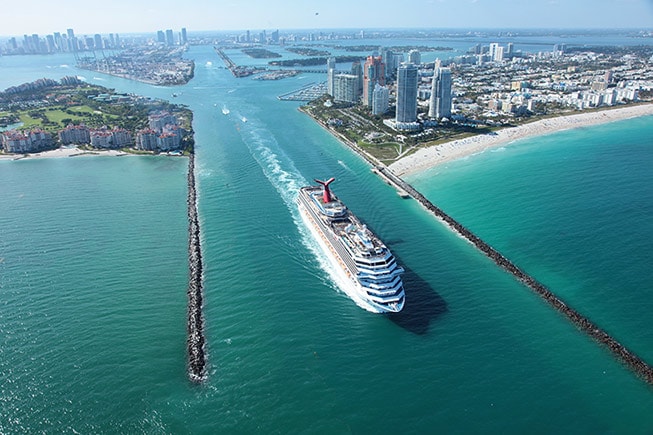
| Carnival cruise ship sailing from Miami - the gateway to Caribbean adventures Photo: Carnival Cruises |
Fresh off exploring the jungles and canals of Panama, we traded rainforest humidity for a different kind of humidity entirely - flying from our perfectly ordinary Washington, DC suburb to the land of neon, art deco, and tropical heat: Miami, Florida! Florida's famous Magic City sits on what geologists call the Miami Limestone formation, basically a giant hunk of ancient coral reef that decided it wanted to be land instead. How ambitious!
The next day, our Carnival cruise ship, the Carnival Imagination (what a name for a vessel!), sets sail from Miami. Watching that massive floating hotel navigate out of the Port of Miami - which happens to be the world's busiest cruise port - is like watching a ballet, if ballerinas were 100,000-ton steel giants.
Here's a fun geology fact: the Caribbean Sea we're sailing into sits on the Caribbean Plate, which is slowly crashing into the North American Plate. This tectonic drama party created the islands we're visiting and also explains why there are occasional earthquakes in the region. Don't worry, cruise ships are basically earthquake-proof floating resorts!
Miami to Cozumel Caribbean Cruise via Key West, Playa del Carmen and Tulum Ruins — Post Summary
We sail the Carnival Imagination out of Miami on a four-day Caribbean run, stopping first at the offbeat micronation of Key West before crossing to Cozumel's reef-fringed shores. A ferry hop lands us in Playa del Carmen, and just south of it we climb the cliffs of Tulum, the only Maya city built right on the sea.
| What's Covered | |
| 🚢 | Miami to Key West — Port of Miami departure, Florida Straits history |
| 🏝️ | Key West: The Conch Republic — 1982 secession, Florida Reef Tract |
| 🐠 | Cozumel: Caribbean's Underwater Playground — Mesoamerican reef, Ixchel pilgrimage |
| 🏖️ | Playa del Carmen: Beaches and Fifth Avenue — Xaman-Ha origins, Riviera Maya |
| 🏛️ | Tulum: The Ancient Maya City by the Sea — cliffside ruins, El Castillo lighthouse |
Miami to Cozumel Caribbean cruise via Key West, with a visit to the 13th-century Maya city of Tulum.
We sailed the Carnival Imagination from Miami to Cozumel, Mexico, with stops in Key West and a side trip from Cozumel into Playa del Carmen and the cliffside ruins of Tulum. The four-day route packs Florida quirk, Mexican Maya history, and some of the clearest water in the Caribbean into one cruise. Here's everything we saw along the way, geology, gossip, and Guacamole included.
Method: Carnival Imagination cruise ship, with a ferry hop from Cozumel to Playa del Carmen
Distance / Time: Approx. 4-day round-trip cruise out of the Port of Miami
Themes: Caribbean geology · Maya history · island culture
Vessel: Carnival Imagination
Route at a Glance
- Miami — Port of Miami departure aboard the Carnival Imagination
- Key West — southernmost point of the continental US, Conch Republic territory
- Cozumel — Mesoamerican Barrier Reef System, Maya pilgrimage island
- Playa del Carmen — ferry crossing, Riviera Maya beaches, Fifth Avenue
- Tulum — cliffside Maya ruins overlooking the Caribbean Sea
Miami to Key West: A Seafaring Start
Setting sail from Miami to Cozumel with a Key West pit stop is like hitting the trifecta of Caribbean awesomeness. You get Florida's quirky personality, Mexico's ancient history, and enough turquoise water to fill a million swimming pools. It's basically the ultimate Caribbean sampler platter.
Miami grew up around the Mayaimi, a Native American people whose name meant "big water," and grew into a melting pot of Cuban, Caribbean, and American cultures. The city's Art Deco district in South Beach has more pastel colors than a bag of Easter candy, which perfectly sets the mood for a tropical adventure.
Florida's coastline has more cruise traffic than most highways have cars. Each year, millions of passengers sail from Miami to visit the islands. The logistics are impressive - think floating cities needing precise docking schedules and endless supplies of sunscreen.
 |
| Carnival Imagination departing Miami, ready for Caribbean adventure CC BY-SA 4.0, Link |
Miami sits at the mouth of the Miami River, which Native Americans used as a canoe highway for thousands of years. Today, instead of canoes, we have cruise ships that could probably hold a small village worth of people. That's progress, apparently.
The Florida Straits we're sailing through have some serious history - this was the main route for Spanish treasure ships heading back to Europe loaded with gold and silver. Pirates loved this area for obvious reasons. Today, the only pirates you'll find are the ones selling overpriced souvenirs.
Sailing through these waters feels like traveling through layers of history. Below us lie shipwrecks from centuries of maritime traffic, while above, modern navigation systems keep us safely on course. The sea has stories in every wave.
Key West: The Conch Republic
Key West! This tiny island at the southernmost point of the continental U.S. has more personality per square foot than anywhere else. The island's limestone foundation creates the perfect conditions for coral reefs, which is why the waters here are ridiculously clear. It's like nature's giant aquarium.
_sits_moored_at_the_Outer_Mole_Pier_in_Key_West,_Fla.,_opposite_the_Carnival_cruise_ship_(cropped).jpg#/media/File:US_Navy_041217-N-4779D-042_USS_John_L._Hall_(FFG-32)_sits_moored_at_the_Outer_Mole_Pier_in_Key_West,_Fla.,_opposite_the_Carnival_cruise_ship_(cropped).jpg "Carnival Imagination at Key West with US Navy vessel") |
| Carnival Imagination docked at Key West with US Navy ship nearby U.S. Navy photo by Journalist 1st Class Trice Denny, Public Domain, Link |
Key West has this hilarious history of declaring itself the Conch Republic in 1982 after the U.S. Border Patrol set up a checkpoint. The locals staged a secession that lasted one minute before surrendering and demanding foreign aid. Only in Florida, folks!
The island's coral reefs are part of the Florida Reef Tract, the only living coral barrier reef in the continental United States. These reefs are home to more species than a New York City subway during rush hour - colorful fish, sea turtles, and if you're lucky, maybe even a dolphin or two showing off for the tourists.
Key West's geography makes it a natural transition point between the Gulf of Mexico and the Atlantic. The meeting of these waters creates unique marine ecosystems and explains why the fishing here is legendary. Hemingway knew what he was doing when he settled here.
Cozumel: Caribbean's Underwater Playground
From Key West, we head to Cozumel, Mexico - an island that's basically the Caribbean's underwater playground. Cozumel sits on the Mesoamerican Barrier Reef System, the second largest coral reef system in the world. It's like the Great Wall of China, but wetter and with more fish.
 |
| Cruise ships docked in Cozumel, Mexico - floating city convention By Whiskey5jda - Own work, CC BY-SA 4.0, Link |
Cozumel has this incredible Maya civilization history - it was a sacred pilgrimage site for Ixchel, the Maya goddess of fertility, medicine, and the moon. Women would make the journey to the island to seek her blessings. Today, people make the journey for different blessings - like blessing their Instagram feeds with amazing beach photos.
The island's name comes from the Maya Cuzamil, meaning land of the swallows. These migratory birds still visit the island, probably wondering what all these giant floating hotels are doing in their favorite vacation spot.
Cozumel's modern economy revolves around tourism, but traditional fishing and handicrafts remain important. The island has managed to balance development with environmental protection, making it a model for sustainable Caribbean tourism.
Playa del Carmen: Beaches and Fifth Avenue
From Cozumel, we hop on a ferry to Playa del Carmen on the mainland. This area of Mexico's Yucatán Peninsula has more geological surprises than a magician's hat. The entire peninsula is basically a giant limestone slab with underground rivers and sinkholes called cenotes - natural swimming pools created when cave ceilings collapse.
Playa del Carmen was once a sleepy fishing village called Xaman-Ha (Maya for waters of the north). Today, it's a bustling tourist hub that somehow manages to balance beach relaxation with vibrant nightlife. It's like if Miami and a yoga retreat had a baby.
 |
| Beach at Playa del Carmen, Mexico - pristine white sand and turquoise waters By Haakon S. Krohn - Own work, CC BY-SA 3.0, Link |
The beaches here are part of the Riviera Maya, which stretches along the Caribbean coast. The sand is so white because it's made of crushed coral and shells - nature's version of a sandblasting treatment.
Playa's famous Fifth Avenue (Quinta Avenida) is a pedestrian street that runs parallel to the beach. It's lined with shops, restaurants, and bars where you can find everything from authentic Mexican tacos to souvenirs that scream "I went to Mexico and all I got was this overpriced t-shirt."
The development along Mexico's Caribbean coast has been rapid but mostly thoughtful. Environmental regulations protect sea turtle nesting sites, and many resorts participate in coral restoration projects. Tourism dollars fund conservation - a nice symbiotic relationship.
 |
| Quinta Avenida at night in Playa del Carmen - vibrant shopping and dining street By XXMaxusXx - Own work, CC BY-SA 4.0, Link |
Tulum: The Ancient Maya City by the Sea
Just south of Playa del Carmen lies Tulum ruins, the only Maya archaeological site built right on the coast. This place has better ocean views than a billionaire's yacht. Tulum was a major trading port between the 13th and 15th centuries, dealing in everything from jade to chocolate to feathers.
What's incredible about Tulum is its location. It sits on 12-meter (39-foot) cliffs overlooking the Caribbean Sea, which gave the Maya traders a perfect vantage point to spot incoming canoes. It was basically the ancient version of air traffic control, but for boats.
 |
| Tulum ruins perched on cliffs overlooking Caribbean Sea By Dronepicr - Own work, CC BY 3.0, Link |
Tulum is part of the Sian Ka'an Biosphere Reserve UNESCO World Heritage site, which means it's protected land that's home to incredible biodiversity. Sian Ka'an means Origin of the Sky in Maya, which is pretty poetic for a place that's basically nature's greatest hits album.
The most famous structure at Tulum is El Castillo (The Castle), which served as both a temple and a lighthouse. Yes, a lighthouse. The Maya would light fires at the top to guide traders through the reef at night. Ancient GPS, if you will.
Another cool structure is the Temple of the Frescoes, which still has some of its original paint. The Maya used colors made from minerals and plants - talk about organic paint. The descending god carved above the door might represent the setting sun or Venus, which the Maya tracked with impressive accuracy.
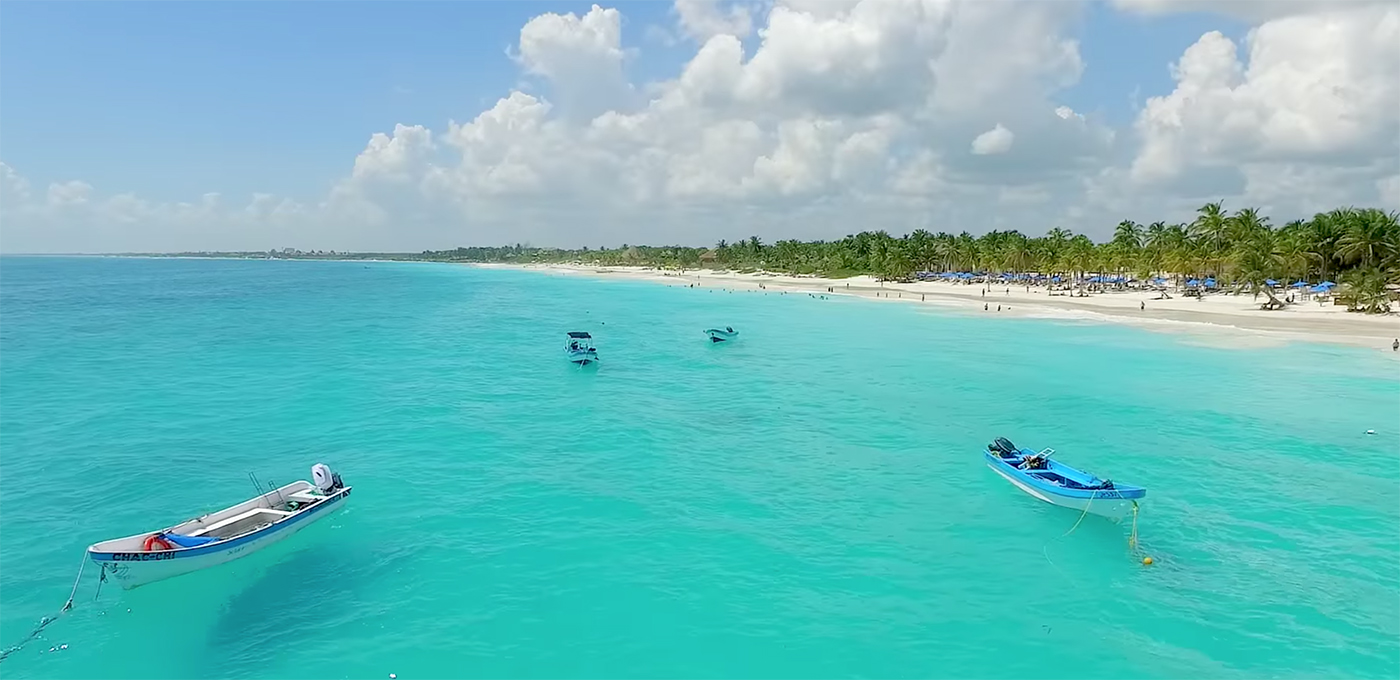 |
| Tulum beach below the ruins - where ancient history meets modern relaxation |
Below the cliffs of Tulum lies one of the most beautiful beaches in Mexico. The water here is that perfect Caribbean turquoise that makes every photo look like it was filtered by a professional. The beach is accessed through a break in the cliffs - the same path Maya traders used centuries ago.
The whole region sits on the Yucatán Platform, a massive limestone shelf that creates those stunning cenotes (sinkholes) when rainwater dissolves the rock. The Maya considered cenotes sacred gateways to the underworld. Today, they're mostly considered gateways to awesome Instagram photos.
From the limestone bones of Florida to the limestone bones of the Yucatán, this whole route turned out to be one long lesson in how much the Caribbean owes to ancient reefs and the civilizations that built on top of them. Spanish galleons, Maya traders, and a cruise ship full of sunburned tourists have all, in their own centuries, used the same currents and the same coastline to get somewhere worth arriving at.
So there you have it - a journey from Miami's modern glamour to the ancient walls of Tulum, with plenty of geology, history, and humor along the way. Whether you're into coral reefs, Maya ruins, or just really good margaritas, this Caribbean cruise route has something for everyone. Just don't forget the sunscreen - the Caribbean sun doesn't mess around.
Next stop: Canaan Valley, West Virginia - proof that we can do mountains as enthusiastically as we do beaches.
