
 |
| Hydra, Greece |
Our July 2021 Southern and Eastern Europe journey carried us from Istanbul to Pamukkale and then onward to Athens. From our base near the Acropolis, we set out for Hydra by metro and hydrofoil, turning a Greek island day trip into a small public-transport relay race.
Hydra, written Ύδρα in Greek and sometimes rendered as Idra, sits in the Saronic Gulf. Reaching it from Athens meant crossing the city, finding the correct ferry gate in Piraeus, and returning before the final boat and train stopped caring about our plans.
Athens to Hydra via Piraeus and Hydrofoil — Post Summary
This July 2021 day trip begins at Acropoli Metro Station, passes through Omonia, Neo Faliro, and Piraeus, then crosses the Saronic Gulf by hydrofoil to Hydra. We stop along the harbor, walk past defensive cannons, stone mansions, museums, and traffic-free lanes, then test the final ferry and last train back to Athens. No truck, no border paperwork, just several timetables behaving like minor deities.
| What's Covered | |
| ▸ | Route at a Glance — metro, port, hydrofoil, harbor, and return in sequence |
| ▸ | Acropoli Metro Station to Omonia — archaeological displays and a central Athens transfer |
| ▸ | Omonia to Neo Faliro and Piraeus — Line 1, railway history, and the port walk |
| ▸ | Flying Dolphin from Piraeus to Hydra — hydrofoil technology and the Saronic Gulf crossing |
| ▸ | Hydra Harbor and Isalos Cafe — restricted traffic, waterfront activity, and our cafe stop |
| ▸ | Hydra’s Bastions and Maritime History — defensive cannons, shipping wealth, and independence |
| ▸ | Stone Mansions, Museums, and Harbor Lanes — historic homes, archives, cathedral, and artists |
| ▸ | Hydra Coast, Food, and Island Paths — Spilia, Vlychos, seafood, and the Prophet Elias route |
| ▸ | Last Ferry from Hydra and Last Train to Athens — dark crossing and the final rail connection |
We traveled from central Athens to Hydra by metro, a short walk through Piraeus, and a Flying Dolphin hydrofoil. The route crossed the city, the port, and the Saronic Gulf before returning after dark. This post follows the transfers, Hydra harbor, the island’s maritime history, and the final ferry and train home. The plan looked simple on paper. Schedules enjoy that sort of confidence.
Method: Athens Metro, walking, and passenger hydrofoil
Distance / Time: Piraeus–Hydra ferry leg about 1 hour 30 minutes each way; full-day return trip
Themes: Athens transit · Saronic Gulf crossing · Hydra maritime history
Route at a Glance
- Acropoli Metro Station — morning departure near the Acropolis
- Omonia Square — brief city stop and transfer to Line 1
- Neo Faliro — final coastal station before Piraeus
- Port of Piraeus — walk from the station to the ferry terminal
- Hydra harbor — arrival, waterfront break, and town walk
- Harbor bastions — cannons and the island’s naval past
- Hydra lanes and waterfront — mansions, museums, food, and sea views
- Piraeus to Acropoli — Line 1 to Omonia, then Line 2 to Acropoli
Acropoli Metro Station to Omonia
 |
| Acropoli Metro Station |
Acropoli station was closest to our hotel near the Acropolis, so it started the day. The station sits in the Makrygianni area, close to the Acropolis Museum and Plaka. Archaeological finds uncovered during metro construction are displayed inside. In Athens, digging a railway can become an archaeology project before anyone finishes the first tunnel.
 |
| Acropoli Metro Station |
The exhibits made the station more than a place to wait for a train. They tied the modern metro to the ancient city above it, where almost every layer of ground appears to have previous tenants.
 |
| Acropoli Metro Station |
We took the metro to Omonia and stepped out for another look at the square. Omonia has long been one of central Athens’s main meeting points and transport junctions. Our useful reason for stopping was the transfer to Line 1 toward Piraeus. Our less useful reason was curiosity, which remains the most expensive free activity in travel.
 |
| Omonia |
Omonia mixed old commercial buildings, newer storefronts, traffic, and a steady flow of people changing direction. It was less a pause in the journey than another moving part of it.
 |
| Gamestation at Omonia Square |
Gamestation gave us a small detour among video games, consoles, and accessories. It felt familiar to stores back home in Maryland. Ancient Athens could wait a few minutes. Civilization had produced game controllers too.
 |
| Omonia Square |
From Omonia, Line 1 carried us south toward the port. The city thinned, the tracks drew closer to the coast, and the day changed from an Athens outing into an island run.
Omonia to Neo Faliro and Piraeus
 |
| Neo Faliro Metro Station |
We got off briefly at Neo Faliro, the station immediately before Piraeus on Line 1. The coastal setting signaled that the harbor was close, although “close” is a word that often expands when ferry gates and luggage are involved.
 |
| Piraeus Metro Station |
Greece’s first railway line opened between Thissio and Piraeus in 1869. The grand Line 1 station building seen today came later, opening in 1928. The railway is nineteenth-century; the building is not. History had changed trains.
 |
| Piraeus Metro Station |
Piraeus station faces the port and remains a practical gateway to ferries serving the Greek islands. We left the station and walked to the terminal. The port is large enough to punish vague directions, so knowing the gate matters more than admiring one’s sense of adventure.
Flying Dolphin from Piraeus to Hydra
 |
| Flying Dolphin at Port of Piraeus |
At the terminal, we boarded a Hellenic Seaways Flying Dolphin for Hydra. The crossing was short enough for a day trip, provided we respected the return schedule. The schedule, as usual, had no emotional investment in us.
 |
| Passenger seating deck of Flying Dolphin |
Flying Dolphins use hydrofoil technology. As the vessel gains speed, foils beneath the hull generate lift and raise much of the boat above the water, reducing drag. The result is a fast crossing with the distinct sensation that the boat has decided normal boating is inefficient.
The passenger cabin was enclosed and arranged more like an aircraft than a conventional open-deck ferry. We settled in while Piraeus fell behind and the Saronic Gulf took over the windows.
Hydra Harbor and Isalos Cafe
 |
| Hydra, Greece |
The first wide view showed Hydra rising around a horseshoe-shaped harbor lined with stone houses. The port was compact enough to read at a glance and busy enough to change by the minute.
 |
| Hydra harbor |
Private motor traffic is tightly restricted on Hydra, and bicycles are prohibited. Most movement around town happens on foot. Mules and handcarts carry goods on land, while water taxis serve places along the coast. It is a transport system with fewer horns and considerably more hooves.
 |
| Isalos Cafe, Hydra |
We stopped at Isalos Cafe on the waterfront for coffee, fresh juice, omelets, and pastries. Ferries, fishing boats, yachts, workers, and passengers moved around the harbor while we sat still for a useful interval. The Vagabond Couple is not affiliated with Isalos Cafe, and nobody paid us to sit down. Gravity handled that.
 |
| Hydra harbor |
From the cafe, the harbor’s layout was easy to follow. The town climbed behind the waterfront, the ferry quay stayed busy below, and old defensive positions watched from both sides of the entrance.
Hydra’s Bastions and Maritime History
 |
| Cannon at Hydra |
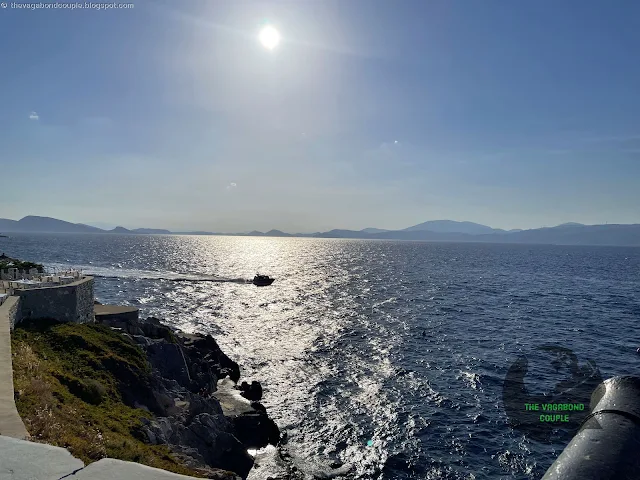
Hydra’s harbor bastions still carry large cannons that once helped defend the port against raids and wartime attack. Their position covered the approaches to the harbor. Today they mostly defend excellent views, a duty performed with admirable silence.
 |
| Cannon at Hydra |
Hydra’s wealth came from shipping and trade. During the Greek War of Independence, the island contributed ships, crews, supplies, and money to the struggle against Ottoman rule. The guns, captains’ houses, and harbor all belong to that maritime story. Calling Hydra merely pretty would be accurate in the same way that calling a ship damp is accurate.
Stone Mansions, Museums, and Harbor Lanes
 |
| Historic stone mansions of Hydra |
The large stone mansions around the harbor were built during Hydra’s naval prosperity in the late eighteenth and early nineteenth centuries. Many belonged to shipowners and political families. Their tall, restrained walls made wealth look stern, which was a popular architectural hobby at the time.
 |
| Historic stone mansions of Hydra |
The Historical Archives Museum stands beside the port and holds documents, relics, books, and objects tied to Hydra and modern Greek history. The Lazaros Kountouriotis Historical Mansion, built in the late eighteenth century, operates as a branch of the National Historical Museum. Kountouriotis gave ships, crews, and much of his fortune to the independence cause. The house therefore comes with both furniture and consequences.
 |
| Narrow alleys between stone buildings in Hydra |
Behind the waterfront, narrow stone lanes climbed between high houses, arched windows, wooden doors, and bougainvillea. With cars and bicycles absent, the streets belonged to walkers, cats, and working animals. The cats appeared to have negotiated the strongest contract.
 |
| Narrow alleys between stone buildings in Hydra |
The quiet was not absolute. Hooves struck the paving stones, children called across the lanes, and harbor sounds drifted uphill. It was simply a town where engines did not control every conversation.
 |
| Hydra |
At the center of the harbor stands the Cathedral of the Assumption of the Virgin Mary, part of a historic seventeenth-century monastery complex. Its bell tower is one of the port’s main landmarks. The religious complex, sea captains’ houses, and defensive guns sit within a short walk of one another because Hydra did not waste space on long commutes.
 |
| Hydra harbor |
Hydra also became a home and working place for artists and writers. Leonard Cohen bought a house on the island in 1960 and spent important parts of his early writing life there. Galleries and summer exhibitions continue that artistic connection, although the island has wisely declined to become quiet about it.
Hydra Coast, Food, and Island Paths
 |
| Hydra |
Hydra’s tavernas serve seafood dishes common around the Saronic Gulf, including grilled octopus and shrimp saganaki. We kept our own stop simpler at the cafe, but the harbor made a persuasive dining room. The view charged nothing. The menu had other ideas.
 |
| Aegean Sea, Hydra |
Near town, Spilia is a set of rocks and swimming platforms rather than a sandy beach. Farther west, Vlychos has a pebble shore and can be reached on foot or by water taxi. Hydra’s shore is rocky, and the water is clear, provided one remembers that rocks are famously unsympathetic to dramatic entrances.
 |
| Aegean Sea, Hydra |
The island’s interior offers long walks with little shade. One established route climbs to the Monastery of Prophet Elias, roughly 500 meters above sea level, and can continue toward Mount Eros, Hydra’s 588-meter summit. Theodoros Kolokotronis was imprisoned at the monastery for a time during the independence struggle. The climb gives wide views across the Saronic Gulf and rewards people who regard uphill as a recreational category.
 |
| Ferry harbor, Hydra |
Back at the waterfront, the light softened over the stone buildings and water. Cafes filled, ferries came and went, and our remaining time began to shrink. Islands are good at making departure times look rude.
Last Ferry from Hydra and Last Train to Athens
 |
| Ferry terminal, Hydra |
Darkness had arrived by the time we boarded the last Flying Dolphin to Piraeus. The return crossing carried us from the island harbor toward the lights and rail lines of greater Athens. Missing that boat would have improved the story and damaged the schedule, so we chose the less literary option.
 |
| Last Train from Piraeus |
At Piraeus, we caught the last Line 1 train to Omonia, then changed to Line 2 for Acropoli. The carriage was quiet, city lights flashed past the windows, and the steady rail noise did most of the talking.
 |
| Last Train from Piraeus |
We chose a carriage with other passengers and stayed aware of our surroundings, the same basic practice we use on late public transport in any large city. Nothing happened. This is the preferred result of sensible precautions, though it rarely gets a documentary series.
You can also watch our video from the day trip:
Watch: HYDRA Day Trip to Stunning Greek Island: A Serene Escape from Athens Greece
This day trip changed the pace of our July 2021 Southern and Eastern Europe journey. Istanbul and Athens had filled the route with major monuments, crowded streets, and urban transit. Hydra reduced one day to rail connections, a fast sea crossing, stone lanes, maritime history, and one strict clock. It was public transport all the way, with no vehicle paperwork and no room for timetable optimism.
After the last train returned us to central Athens, our journey continued through the Acropolis, Plaka, Monastiraki, the Ancient Agora, and the modern streets below the old city. Continue with Unveiling Athens: An Exploration of the Timeless Capital of Greece.
