

|
|
Swamp Safari Village: An American crocodile demonstrates why you shouldn't skip breakfast Swamp Safari Village, Falmouth, Jamaica - where the famous 007 crocodile jump stunt was filmed |
We bailed on the Mid-Atlantic winter like it was a sinking ship. Spirit Airlines flew us to Sangster International Airport in Montego Bay, Jamaica. We traded snow shovels for sunscreen faster than you can say "rum punch."
Our plan was simple. Use a stereotypical Caribbean all-inclusive resort as home base. Explore the Swamp Safari Village. Visit the filming location of the famous crocodile jump from "Live and Let Die". Swim with glow-in-the-dark dinoflagellates at Luminous Lagoon. Hit the crafts market at Ocho Rios. Pay respects at Bob Marley's mausoleum. Basically, we wanted to check every item on our Jamaica travel guide bucket list with enthusiasm.
Here's our complete map of the northern coast route. Spoiler: it involves more crocodiles than your average vacation.
Watch: Exploring the North Coast of Jamaica (YouTube)
Vagabond Tip: The line for customs at Sangster can look apocalyptic, but there's a secret. The far left queue is usually for Jamaican nationals and moves much faster. If you're traveling light and look confident, officials sometimes wave you through.
Montego Bay: Arrival & Highway Adventures
Our airplane did the tourist thing too. It circled Montego Bay, showing off the island like a real estate agent with a hot property. We saw a queue of planes waiting to take off from MBJ. The runway starts where the water ends. It's like airport engineers played chicken with the Caribbean Sea and won.

|
|
Montego Bay from 2,000 feet - the water looks suspiciously photoshopped Final approach to Sangster International Airport, where the runway flirts with the sea |
Montego Bay has the kind of history that involves pirates, which automatically makes it cooler than most places (but not the Omiš on the Adriatic Coast that we explored earlier in the year).
The Taino people were the original residents until Columbus showed up in 1494. He named it "Bahía de Manteca" (Bay of Lard) because of the wild pigs. Classy.
The Spanish got chased out by pirates who loved the hidden coves. Then the British turned it into a sugar and slave trade hub. After slavery ended, they pivoted to tourism. Now you can see colonial mansions like Rose Hall Great House while sipping a drink named after a pirate. Progress?
The A1 Highway: The North Coast Road
Leaving the airport, we hit the A1 highway (North Coast Highway). This vital artery, modernized largely with Inter-American Development Bank (IDB) loans rather than the EU funding that paid for the eastern segment, replaced the potholed nightmares of the past. Lush greenery and glimpses of turquoise water kept us entertained as we cruised along the asphalt.

|
|
The A1 Highway - where reggae beats compete with honking horns Rose Hall Main Road, proving that even infrastructure can be scenic in Jamaica |
Vagabond Tip: For a local SIM, skip the airport kiosks. Drive 5 minutes to any "Digicel" or "Flow" store in town. The plan we got for under US$15 (plenty of data + unlimited social media) is a "Visitor Special" they don't advertise at the airport. Just ask for it.
We stopped at a corner store for local SIM cards. The Flow plan cost us less than US$15. It gave us plenty of data for 7 days plus unlimited YouTube, Spotify and social media. That's cheaper than most airport bottled water.
Discovery Bay: From Columbus to Conveyor Belts
On the way to our resort, we spotted a massive bauxite carrier docked at Port Rhoades in Discovery Bay. Ships here frequently ply the Jamaica-Louisiana bauxite run. This massive bulk carrier ship was loading raw bauxite (the red ore), not alumina (the white refined powder). Jamaica exports these mineral ores like it's going out of style. The conveyor belt leading into the ship looked like a mechanical straw sucking the island's resources.

|
|
The Bulk Patriot loading Jamaica's earth for export Port Rhoades, Discovery Bay - where Columbus first stepped and now ships do the heavy lifting |
Discovery Bay has a name that's literally accurate. Columbus first set foot here in 1494. The Spanish called it "Puerto Seco" (Dry Port) because it lacked fresh water. Pirates loved it in the 1600s. Then it became a sugar production center. Now it's a mineral export hub. The bay has seen more career changes than a Hollywood actor.
Smooth Chinese roads carried us on. Reggae music floated from passing cars. Vibrant markets offered local fruits and crafts. Each mile built anticipation for our Jamaican all-inclusive resort near Runaway Bay.

|
|
More highway, more greenery, same reggae soundtrack A1 Highway proving that the journey matters as much as the destination |
In Jamaica, you drive on the left - a legacy of British colonial rule. Like the UK, India, Australia and several other Caribbean nations, the steering wheel is typically on the right side of the vehicle. This also means you need to rewire your brain when crossing the street: look right, then left, then right again, or you might find yourself part of the local traffic statistics.
Runaway Bay: The All-Inclusive Experience
Runaway Bay is said to get its name from the era of Spanish flight. Legend says the last Spanish governor, Ysassi, fled the British here in 1660. Later, enslaved people used it as an escape route to Cuba. It became part of the underground railroad before there was a railroad. Today it's a tourist spot. The irony is thicker than Jamaican jerk sauce.
We finally reached the all-inclusive resort. These places promise everything. Relaxation, adventure, cultural immersion. They deliver most of it if you ignore the other tourists doing the same thing.

|
|
All-inclusive resort - where "all-inclusive" means "you might not leave" Runaway Bay's ironic luxury at the site of historical escapes |
Resort Life: Pools, Beaches & Buffets
From the moment we stepped onto the grounds, everything was curated. Comfort, enjoyment, unlimited food. It's like being pampered by very attentive robots who also serve drinks.

|
|
The water where you'll forget what day it is All-inclusive resort - hydration with optional swimming |
Picture palm-fringed beaches with white sand. Crystal-clear waters invite swimming, snorkeling, or just lying under the Caribbean sun. The water's so blue it looks filtered. But it's not.

|
|
The pool that makes your phone camera look talented All-inclusive resort's slice of Caribbean perfection in Runaway Bay |
Lush Gardens and Local Flavors
The resort gardens were so lush they seemed to have their own weather system. Tropical flowers we couldn't name bloomed everywhere. The landscaping team clearly had a green thumb and possibly a degree in jungle management.

|
| Slice of the Caribbean at the Jamaican All-Inclusive Resort |
Indulge in Jamaican specialties and international flavors. The resort restaurants serve everything from jerk chicken to pasta. Beachfront bars mix drinks that taste like vacation in a glass.

|
| Our shelter in Jamaica All-Inclusive Resort |
Immerse yourself in Jamaican culture through live music and dance performances. Rum tastings and reggae dance lessons are available. The resort offers authentic experiences, or at least authentic-feeling ones.

|
|
Cake spread next to the stage at the pool. All-inclusive resort's cultural immersion program |
Vagabond Tip: The best jerk chicken at these resorts is never at the main buffet. Find the smaller grill by the beach or pool bar. The chef there usually has more time to cook it right - charred, smoky and falling off the bone. Ask for extra "jerk sauce" on the side.

|
|
Poolside entertainment Everyone becomes a dancer after one drink at the All-Inclusive Resort |
The beach chairs were perfectly aligned like soldiers awaiting inspection. Each one faced the Caribbean Sea with military precision. We claimed our spots and prepared for serious relaxation.

|
| The legal drinking age in Jamaica is 18 years old. Regardless, enforcement is spotty. |
The gardens featured plants that seemed to defy botanical logic. Flowers bloomed in colors not found in nature. Leaves were suspiciously shiny. It was like walking through a plant catalog come to life.

|
| All-you-can-eat: Buffet dinner Part of what's included in All-Inclusive Resort |
Whether you seek romance, family fun, or water sports, Jamaican all-inclusive resorts (like all such resorts across the planet) deliver. Every moment gets tailored to exceed expectations. Or at least meet them with a smile and a cocktail.
Falmouth: Swamps, Spies & Glowing Waters
Visiting Island Swamp Safari Village is an experience that begins with a piece of cinema history. The entrance gates sport a "Trespassers will be eaten" sign - a recreation of the actual warning sign that originally caught the eye of Live and Let Die producers in the 1970s and inspired them to film here. The sign either warns or invites. We chose to believe it was an invitation.

|
|
Trespassers Will be Eaten! The friendliest warning sign in Jamaica Island Swamp Safari Village entrance - where "welcome" comes with teeth |
Located in Falmouth in Trelawny Parish, Island Swamp Safari Village offers one of the most unique things to do in Jamaica: eco-tours through the wetlands. It's easily accessible from cruise ships at Falmouth Jamaica Cruise Port. We chose a walking tour over the boat option. A local guide pointed out flora and fauna. She knew things about plants that would make a botanist blush.

|
|
The boardwalk through Jamaica's liquid jungle Island Swamp Safari Village - where every step could be interesting |
The facility teems with wildlife. In addition to native reptiles like crocodiles and iguanas, the zoo houses mammals like raccoons. You might even see the Jamaican hutia or introduced mongoose. The hutia is a rodent that looks like it can't decide between being a rat or a guinea pig.

|
|
A baby crocodile practicing its menacing stare Island Swamp Safari Village - where even the juveniles look judgmental |
The baby crocodile felt surprisingly heavy and textured. Its scales were like bumpy armor. The guide explained it would grow to about 13 feet and mentioned that crocodiles have a "third eyelid" (nictitating membrane) that acts like built-in swimming goggles. We made a mental note to never swim in murky water, regardless of our eyewear situation.

|
|
Baby crocodile dental plan: all teeth, no brushing required Island Swamp Safari Village's youngest resident practicing intimidation |
Island Swamp Safari Village offers cultural demonstrations too. Traditional Jamaican drumming, dancing, crafts making. These provide insights into Jamaica's vibrant heritage. The drumming might scare away wildlife. Or attract it.

|
|
The raccoon: nature's bandit with better fashion sense than most tourists |
The raccoon looked at us with the confidence of a creature that knows it's adorable. Its little hands seemed ready to pickpocket. We kept our wallets close just in case.

|
|
Peacock showing off like a tourist in new Hawaiian shirt The birds have better outfits than you |
The crocodile feeding demonstrations are the main event. Trained staff interact with crocodiles while providing educational commentary. ing an apex predator eat is both educational and exciting. It makes you appreciate being at the top of the food chain. Mostly.

|
|
American crocodile demonstrating why you shouldn't stick your hand in Swamp Safari Village feeding show - dinner theater with teeth |
The crocodile's jaws snapped shut with a sound like a car door slamming. Chicken pieces disappeared instantly. We gained new respect for prehistoric survival skills.
Vagabond Tip: The crocodile feeding happens twice daily. The 11 AM show gets packed with cruise ship crowds. Go for the 2:30 PM feeding instead - you'll get a front-row view without the elbows. And wear a hat. The sun in that swamp is brutal.
Kananga’s Farm: Filming Secrets from "Live and Let Die"
"Live and Let Die" was Roger Moore's first outing as 007. Jamaica served as a filming location. The island's lush landscapes and vibrant culture attracted filmmakers. For this movie, the production team chose various Jamaican locations.
Please note: if you are looking for the official James Bond Island, that is Ko Tapu or Khao Phing Kan in Phang Nga Bay in Southern Thailand, a part of the Ao Phang Nga National Park about 25 kilometers northeast of Phuket. Sometimes people erroneously refer to Swamp Safari Village here in Jamaica as James Bond Island.
One memorable scene involves 007 navigating a crocodile farm. Island Swamp Safari Village provided the perfect backdrop. Its natural swamp environment and resident crocodiles worked perfectly. Today, the shooting location is famously known as the site of the "Kananga's Farm" escape scene.

|
|
The famous filming location - where 007 walked on crocodiles because walking around was too mainstream Swamp Safari Village's claim to cinematic fame |
Jamaica's inclusion in "Live and Let Die" helped promote tourism. Fans seek out filming locations. They contribute to the local economy and cultural exchange. Or they just want to say they stood where Bond stood. Both are valid.

|
|
Crocodile congregation: nature's original social distancing fails Swamp Safari Village - where Roger Moore once tiptoed |
While Roger Moore looked suave on screen, the famous crocodile-jumping stunt in Live and Let Die was actually performed by the farm's owner, Ross Kananga. It took five takes to get right and in one failed attempt, a crocodile actually snapped the heel off his shoe. The producers were so impressed by his survival skills that they named the film's villain, Dr. Kananga, in his honor.

|
|
Descendants of the crocodiles Roger Moore's 007 walked on Swamp Safari Village - family legacy with teeth |
The crocodiles basking in the sun looked like they were posing for tourist photos. Maybe they knew their ancestors were movie stars. They had that Hollywood attitude.
Watch: James Bond - Live and Let Die (1973) - Crocodile Farm Scene - Roger Moore
"Live and Let Die" incorporated Jamaican music, cuisine and scenery. The film's depiction adds exotic appeal. It contributes to the atmosphere of adventure and intrigue. Paul McCartney's theme song doesn't hurt either.

|
|
Rusted movie prop: when film sets become permanent souvenirs Swamp Safari Village - Hollywood's leftovers |
The inclusion of Island Swamp Safari Village in "Live and Let Die" has boosted Jamaican tourism for decades. Bond fans seek filming locations. They take photos, buy souvenirs and tell stories. The local economy benefits. Cultural exchange happens. And everyone gets to feel a little like 007. Without the crocodile walking, hopefully.
North Coast Attractions Compared
| Attraction | Location | Best For | Vibe | Time Needed |
|---|---|---|---|---|
| Swamp Safari Village | Falmouth | Adventure, Wildlife, Bond Fans | Educational & Thrilling | 2-3 hours |
| Luminous Lagoon | Falmouth | Romance, Photography, Unique Experience | Magical & Otherworldly | Evening (1.5 hours) |
| All-Inclusive Resort | Runaway Bay | Relaxation, Families, Foodies | Pampered & Curated | Multiple Days |
| Nine Mile (Bob Marley) | St. Ann Parish | Music History, Spiritual Journey | Reverent & Authentic | Half Day |
| Ocho Rios Craft Market | Ocho Rios | Shopping, Local Crafts, Bargaining | Chaotic & Colorful | 1-2 hours |
Our journey along Jamaica's north coast was just beginning. We still had the Luminous Lagoon to experience, Bob Marley's legacy to explore and Ocho Rios to haggle at. The Swamp Safari Village adventure set the tone for a trip filled with cinematic history and natural wonders. Jamaica delivers more than postcard perfection - it offers stories with teeth.
The Luminous Lagoon: Jamaica's Glowing Secret
Forget those tiny glow sticks from a rave. Up on Jamaica's north coast, near Falmouth, there's a whole lagoon that parties every night. Welcome to the Luminous Lagoon (also known as Glistening Waters), a world-famous bioluminescent bay where the water literally lights up. It's like Mother Nature installed fiber-optic cables and forgot to send us the bill.

|
|
The Luminous Lagoon at Falmouth at night, where every splash triggers a neon blue light show.
It's the Caribbean's most spectacular natural rave, no cover charge required. Photo credit: Sunny Tours Jamaica |
We hopped on a boat with Mystic Lagoon Tours (no sponsorship, just a good tip) to check out the famous Glistening Waters. Our guide told us the glow isn't magic, but it sure feels like it when you're floating in a sea of stars.

|
|
The Mystic Lagoon Tours dock in Falmouth, where you trade solid ground for liquid starlight.
This is your launchpad to what feels like a sci-fi movie set, minus the aliens. |
Vagabond Tip: Book the last tour of the night (usually around 8 PM). Not only is it darker for a better glow, but the boats are less crowded. And wear a swimsuit under your clothes - you'll want to jump in. The guides keep a bucket of fresh water for a quick rinse afterward.
Most glowing lagoons are shy and faint. But this one is an attention seeker. The key is the unique brackish water mix from the Martha Brae River meeting the sea. It's like a perfectly mixed cocktail for tiny, glowing plankton. They absolutely love it here - scientists estimate there are millions of these dinoflagellates per gallon of water, making it one of the brightest spots on Earth.
This place is biology class on steroids. You get nature's light show plus the science behind it. It's like Disneyland if Disneyland was run by microscopic plankton with a flair for drama.
The Science Behind Jamaica's Glowing Waters
So here's the tea. The glow comes from millions of microscopic party animals called dinoflagellates. The main star is Pyrodinium bahamense. During the day, they're basically invisible couch potatoes. Come nightfall, they turn into the world's tiniest ravers.

|
|
The boat's wake becomes a river of light at the Luminous Lagoon, courtesy of angry plankton.
Every disturbance triggers their defense mechanism: a dazzling blue flash. Photo Credit: Bahia Principe |
Touch the water and they flash. Move your hand and they create light trails. It's their way of saying "Back off!" to predators. Or maybe "Hey, looking good!" to potential dates. Marine biology is complicated.

|
|
A dense bloom of dinoflagellates putting on their nightly light show at the Luminous Lagoon.
The water holds more living lanterns per gallon than Times Square has bulbs. Photo Credit: US News |
The lagoon is the perfect dinoflagellate Airbnb. It's shallow, warm and gets just the right mix of fresh and salt water. The Martha Stewarts of the microbe world couldn't design a better habitat.
Swimming in a Living Galaxy
This isn't just for nerds with microscopes. Regular people like us can jump in. At night, boats head out and people swim in what feels like liquid galaxy.

|
|
Swimming in the Luminous Lagoon means you become a human sparkler.
Every kick and stroke paints the water with temporary, glowing tattoos. |
When you swim, you leave trails of light behind you. It's like being a superhero with glow-in-the-dark powers. We felt like Aquaman's cooler, more luminous cousin.

|
|
A tour boat becomes a chariot of fire on the Luminous Lagoon waters.
The propeller acts like a giant blender, whipping millions of dinoflagellates into a frenzy of light. |
There's a weird local trick we learned. If you scoop water into a bucket and let it sit, the glow fades in about thirty seconds. It's like the plankton get tired of your nonsense and go back to sleep. Try it.
The guides drop some serious science knowledge while you're floating in magic water. They explain the chemical reaction - luciferin and luciferase (from the Latin for "light-bringer," sharing a root with the fallen angel) - that creates the glow. It's biology class where you're part of the experiment.

|
|
A cruise ship excursion experiences the Luminous Lagoon's magic.
Even the big boats can't resist this natural light spectacle. |
Beyond the glow, Falmouth serves up killer beaches, coral reefs that look photoshopped and food that makes you want to move here. The jerk chicken stands alone are worth the trip.
Preserving Jamaica's Natural Light Show
This glowing wonder needs protection. Too many boats or pollution could turn this rave into a sad, dark puddle. Sustainable tourism is key - limiting traffic and keeping the water clean.

|
|
The Luminous Lagoon from above, showing its relationship to the Falmouth coastline.
This fragile ecosystem needs protection to keep glowing for future generations. |
Education is crucial. When people understand these tiny organisms, they're more likely to protect them. We need to be good guests at nature's coolest party.
Sharing these same glowing waters is the Oyster Bay peninsula (map). It's home to the adults-only Excellence Oyster Bay resort, which sits right on the edge of the lagoon. Think luxury suites, spas and turquoise water with a front-row seat to the light show.
Nine Mile: Where Reggae Was Born
Next, we headed to Nine Mile through the wonderfully chaotic Browns Town.

|
|
The vibrant, chaotic main street of Browns Town, St. Ann Parish.
This is real Jamaica - loud, colorful and full of life. |
The Mountain Pilgrimage to Bob Marley's Birthplace
Deep in Jamaica's green mountains lies reggae's holy ground: Nine Mile. A Bob Marley Mausoleum tour takes you to where the legend was born and buried. It's less a tourist spot and more a pilgrimage for anyone who's ever felt a bassline in their soul.
Nine Mile sits in the mountains of Saint Ann Parish. Bob Marley entered the world here on February 6, 1945. The winding roads through green hills show you the Jamaica postcards ignore - raw, rural and real.

|
|
Bob Marley's childhood home in Nine Mile - a humble two-room cabin.
Global superstars often have the most modest beginnings. |
Ever heard of the Revival (Revival Zion) tradition? Before Marley popularized Rastafari, his community was steeped in older Afro-Jamaican spiritual traditions. Revivalism involves spirited drumming, dancing and spiritual connection with ancestors.

|
|
The vibrant, handmade tributes to Bob Marley begin long before you reach the mausoleum in Nine Mile.
Every wall and fence becomes a canvas for his memory. |
Vagabond Tip: The drive to Nine Mile is winding and can be rough. Rent a small SUV, not a sedan. Leave early (by 8 AM) to avoid the midday heat and the tour buses that arrive around 10:30 AM. There's a small, family-run juice stand about halfway up the mountain - stop for the best pineapple juice you'll ever have.
Before the tourists came, Nine Mile was known for something else: pimento, or allspice. The hills are dotted with pimento trees. Locals would harvest the berries and dry them in the sun, filling the air with a warm, sweet scent that mixes with woodsmoke. That's the original aroma of Nine Mile, not just reggae and herb. It's the smell of Marley's childhood.
Village of Rhythm and Color
Nine Mile hits you with color and sound. Reggae pours from speakers, murals cover walls and the vibe is pure authenticity. It's the opposite of the polished tourist coast.

|
|
The humble gateway to a global legend's final resting place at the Bob Marley Mausoleum in Nine Mile.
Even icons need a ticket booth. |
The ubiquity of red, gold and green in these murals isn't just a Jamaican aesthetic; they are specifically the colors of the Ethiopian flag. Rastafarianism is deeply rooted in the veneration of former Ethiopian Emperor Haile Selassie I, meaning this Caribbean cultural phenomenon is visually anchored to a nation over 7,500 miles away in East Africa.
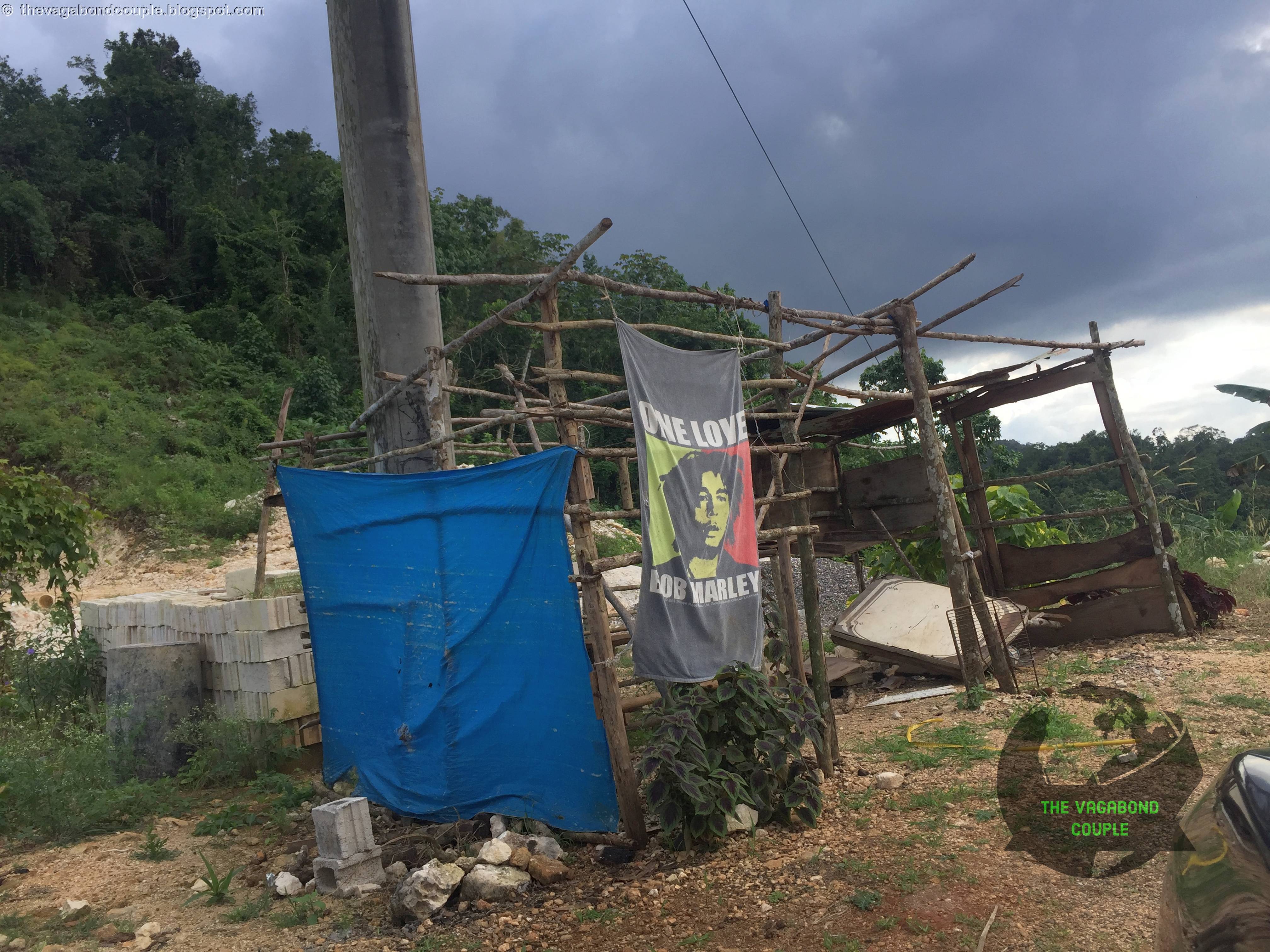
|
| Found Bob’s favorite shack in the middle of nowhere. No Bob though, just us, questionable shelter engineering and incoming rain clouds. 🌧️ One Love is the village motto at Nine Mile. |
When Bob Marley was buried in the mausoleum just up the hill, he didn't travel light. He was interred with a specific set of items to accompany him: his red Gibson Les Paul guitar, a soccer ball, a Bible opened to Psalm 23 and a stalk of marijuana, creating what is arguably the most rhythmically spiritually equipped time capsule in history.
The street art isn’t trying to be fancy. It just shows up, loud and proud. Walls splash with red, gold and green. Bob Marley’s face watches you from half-faded murals, looking calm while goats wander past like unpaid security. The paint peels, the music drifts from somewhere unseen and the hills sit quietly in the background like they’ve heard every song before. It’s not gallery-perfect. It’s better. It’s real, sunburnt and humming softly to itself.

|
| “Land of Legends” sign tucked in the jungle. Felt more like “land of bugs and sweat,” but still pretty.. |
You can tour Bob's childhood home - a simple two-room cabin. It's humbling. The bedroom where he dreamed and the kitchen where his mother Cedella cooked are preserved. Keep an eye out for the "Single Bed." While tour guides insist this bed inspired the line "We'll share the shelter of my single bed" in Is This Love, the song actually refers to his adult struggles living with Rita in the Trench Town government yard in Kingston.

|
|
A historical poster in Nine Mile showing Marley's influence beyond music into politics.
His 1978 "One Love Peace Concert" brought warring political leaders together on stage. |
The Sacred Mausoleum and Its Air
At Nine Mile's center is the Bob Marley Mausoleum. Surrounded by green hills, it's where Bob rests after his death on May 11, 1981, at just 36. The place is peaceful, decorated with murals of his life.

|
|
The interior of his grandparents' home in Nine Mile, where extended family lived.
Life here was communal, simple and deeply connected to the land. |
Leaving the cabin's close, dusty quiet for the churchyard is like walking from a library into a rock concert. The light punches you in the eyeballs. But the real star is the air. It’s not just fresh; it’s performatively fresh, like it’s showing off. It carries a signature scent - wet dirt, sweet ginger lilies and the distant, electric tang of a storm that’s thinking about ruining someone’s day over in the next parish.
Old-timers here swear this "Nine Mile air" has a cognitive effect. They claim its pristine clarity sharpens thoughts and tunes the ears, which would make it the world's only proven atmospheric talent scout. It explains a lot. The village didn't just produce Bob Marley; it has a suspiciously high density of poets, singers and people who can argue rhythmically for hours. The conclusion is inescapable: the music wasn't just in the people. It was in the humidity. Marley didn't write "One Love." He just transcribed what the breeze was humming.

|
|
The breathtaking view Bob Marley grew up with from the Nine Mile mausoleum.
These green hills and valleys are the original source of that laid-back reggae rhythm. |
The original mausoleum wasn't this ornate. For years after his death, Marley was buried in a simple crypt near his mother's house in Kingston. The move to Nine Mile and the construction of this marble and limestone structure happened later, fulfilling a wish he'd expressed to be buried "where my journey began." The journey to bring him home was a national event, with thousands lining the mountain roads.

|
|
The vast, quiet beauty of Saint Ann Parish surrounding Nine Mile.
This solitude and connection to nature deeply influenced Marley's spirituality. |
Inside, you can pay respects at his burial site. The air is thick with reverence. People stand quietly, some crying, all connected by his music.

|
|
Sacred herb growing freely on the Nine Mile mausoleum grounds, as it would have in his time.
For Rastafarians, cannabis is a sacrament, not a recreational drug. |
The "herb" here isn't just for show. In Rastafari tradition, it's called the "wisdom weed" and is used to aid meditation and prayer. Locals here often cultivate Lamb's Bread (or Lamb's Breath), a legendary Jamaican landrace sativa said to be Marley's favorite for its uplifting, creative effects. It's not the super-high-THC monster of modern dispensaries, but an older, clearer variety. Smoking it here is considered part of the spiritual experience, not a party trick.
The Never-Ending Legacy of a Global Icon
Bob Marley's influence is global. His music - from "No Woman, No Cry" to "Get Up, Stand Up" - still speaks about love, struggle and unity. He was a musician, but also a voice for justice.

|
|
The music never stops at the Bob Marley Mausoleum in Nine Mile. Local musicians keep the reggae rhythm alive daily.
This isn't a museum; it's a living, breathing cultural center. |
His message of fighting oppression and seeking equality turned him into a global symbol. Through reggae, he inspired millions to imagine a better world.

|
|
The humble origins of a king in Nine Mile. This cabin is reggae's Bethlehem.
From these two rooms, a sound conquered the world. |
There's a local belief, not widely shared with tourists, that on certain nights when the mist hangs low in the Nine Mile valleys, you can hear the faint, ghostly echo of a guitar. The old-timers say it's Bob, still practicing. We didn't hear it, but we definitely listened extra hard.

|
|
The bed where the dream began in Nine Mile. No luxury, just basic comfort.
Great art often springs from simple circumstances. |
The bedframe is original, but the mattress? Definitely not. We asked. After decades of pilgrims wanting to touch it, the original straw mattress disintegrated. The current one is a respectful replica. Still, it's weirdly powerful to see the actual space where a legend dreamed.

|
|
A permanent stone marker in Nine Mile ensures the Bob Marley story is never forgotten.
Pilgrims leave tokens, notes and prayers here daily. |
Ocho Rios: Jamaica's Ultimate Playground
Ocho Rios on the north coast has it all: killer beaches, rainforests, waterfalls and more tourists per square foot than anywhere else in Jamaica. It's a cruise ship hub, so expect crowds, but also epic Ocho Rios excursions and adventures.
First stop: the Ocho Rios Craft Market. It's chaotic, colorful and full of handmade treasures. You can bargain for wood carvings, vibrant textiles and jewelry. The air smells like spices and possibility.

|
|
The vibrant, slightly overwhelming Ocho Rios Craft Market.
Your negotiation skills will be tested, but the souvenirs are worth it. |
Vagabond Tip: At the Ocho Rios Craft Market, never pay the first price. Start at 40% of what they ask and settle around 60-70%. The best deals are in the back corners, not at the front stalls. And if someone offers to "show you something special," it's probably just a more expensive version of what's out front.
Then there's jerk chicken. Roadside stands serve it smoky, spicy and life-changing. It's the unofficial national dish for a reason.
The crown jewel is Dunn's River Falls. You climb 600 feet along the terraced limestone falls (ascending about 180 feet in elevation) while water cascades around you. Guides help you form a human chain. It's part hike, part water park, all awesome.
For animal lovers, Dolphin Cove lets you swim with dolphins, touch stingrays and even see sharks safely. It's touristy but creates those "did that really happen?" memories.
The coastline here boasts some of the best beaches in Jamaica. Turtle Beach buzzes with energy. A short drive east brings you to James Bond Beach in Oracabessa (yes, that James Bond), which offers quieter turquoise waters. You can snorkel, dive, or just perfect your tan.
Just to make sure you understand what James Bond Beach is: if you are suffering from writer's block, we suggest a pilgrimage to this beach near Ocho Rios. The visit might cure you, or it might just make you feel completely inadequate. This stretch of coastline offers the kind of quiet, turquoise water that typically inspires naps. Ian Fleming, however, lived nearby at his Goldeneye estate and somehow concentrated enough to write the 007 novels (though he famously wrote with the blinds closed to ignore the view). We usually look at the horizon and think about lunch. Fleming looked at it and decided the view needed more explosions. He really set a terrible precedent for working from home.
Beyond the coast, Mystic Mountain offers zip-lining through rainforest canopy, bobsledding on tracks and aerial trams with killer views. It's an adrenaline factory with a green backdrop.

|
|
The Bob Marley cocktail: red, gold and green layers in a glass.
When you can't visit Nine Mile, you can at least drink its colors. |
Ocho Rios wraps up Jamaica perfectly: natural beauty, vibrant culture and enough adventure to exhaust you happily. It's the island's lively, crowded, unforgettable playground. From the glowing waters of the Luminous Lagoon to the reggae roots of Bob Marley's Nine Mile and the cinematic shores of Swamp Safari Village, this island never stops surprising you.
Want to hear more of our caribbean stories? Head to Panama, Cozumel, Dominican Republic and even Bahamas which, despite being a part of North Atlantic Ocean's Lucayan Archipelago, doesn't mind being dragged into the caribbean party.
One Love!
- The Vagabond Couple
