
 |
| Glacier Point — Half Dome and Nevada Fall behind us. Yosemite supplied the granite; we supplied the hats. |
Part 11 left us on CA-190 after a full day in Death Valley’s badlands, salt flats, film locations and 130°F roadside heat. We were still below sea level, Shehzadi was still behaving better than we were, and the Sierra Nevada had begun blocking the western horizon with considerable confidence.
This chapter climbs from Furnace Creek through Panamint Valley and the Alabama Hills, follows US-395 beneath the Eastern Sierra, crosses Tioga Pass into Yosemite, and returns the next morning for Mariposa Grove, Tunnel View, Glacier Point, Olmsted Point and Tenaya Lake. The desert-to-alpine change took two days. California apparently dislikes gradual transitions.
Trans-America Part 12 — Post Summary
From Furnace Creek, we drove west on CA-190 to US-395, turned north through Lone Pine beneath the Eastern Sierra, crossed Tioga Pass into Yosemite and reached Oakhurst. The next morning, we returned through the South Entrance for Mariposa Grove, Tunnel View and Glacier Point, then crossed the high country to Olmsted Point, Tenaya Lake and Tioga Pass.
| What's Covered | |
| 🏜️ | Leaving Death Valley on CA-190 — Panamint Valley and Father Crowley Vista Point |
| 🎬 | Lone Pine and the Alabama Hills — rounded granite and film history |
| 🛣️ | US-395 through Owens Valley — Seven Pines, Big Pine and the Palisades |
| 🏔️ | Tioga Pass into Yosemite — Ellery Lake, Tioga Lake and the Sierra crest |
| 🎟️ | Three-hour Yosemite transit — Tioga Pass to Oakhurst without stops |
| 🌙 | Oakhurst overnight — supplies, dinner and a few hours off the road |
| 🌲 | Mariposa Grove — giant sequoias, the Grizzly Giant and the California Tunnel Tree |
| 📸 | Yosemite by road — Tunnel View, Glacier Point, Olmsted Point and Tenaya Lake |
| 🧭 | Next stop — Fresno, Route 66, Punjabi dhabas and the Grand Canyon |
We drove Shehzadi, our 2024 Toyota Tundra, from Furnace Creek in Death Valley to Oakhurst by way of CA-190, Lone Pine, US-395, Tioga Pass and Yosemite National Park. The next morning, we returned through Yosemite’s South Entrance, walked among the giant sequoias of Mariposa Grove and crossed the park again to Tenaya Lake and Tioga Pass. This was a two-day run from desert floor to Sierra crest, with enough granite to make a countertop salesman emotional.
Method: Overland by truck on CA-190, US-395, Tioga Road, Wawona Road and Glacier Point Road
Distance / Time: Approx. 600 miles / 2 days
Themes: desert-to-alpine driving · Eastern Sierra · giant sequoias · Yosemite geology
Vehicle: Shehzadi (2024 Toyota Tundra)
Route at a Glance
- Furnace Creek to Panamint Valley — climbing west from below sea level on CA-190
- Father Crowley Vista Point — Rainbow Canyon and Panamint Valley
- Lone Pine and the Alabama Hills — rounded granite and a century of film locations
- US-395 through Owens Valley — Seven Pines, Big Pine and the Palisades
- Tioga Pass — Ellery Lake, Tioga Lake and Yosemite’s eastern entrance
- Tioga Pass to Oakhurst — a three-hour transit across Yosemite
- Oakhurst — overnight below Yosemite’s South Entrance
- Mariposa Grove — giant sequoias, the Grizzly Giant and the California Tunnel Tree
- Tunnel View to Glacier Point, Olmsted Point, Tenaya Lake and Tioga Pass
Leaving Death Valley on CA-190
We left Furnace Creek early and aimed Shehzadi west on CA-190. The road climbed from below sea level and dropped toward Panamint Valley, trading the white glare of the salt basin for dark ridges and open desert. California was changing floors without using an elevator.
 |
| CA-190 in Panamint Valley — Death Valley’s basin gave way to another broad desert trough. |
Panamint Valley looked quieter than Death Valley, though “quiet” still involved a full-size truck, hot pavement and mountains on every side. At Father Crowley Vista Point, the useful view is into Rainbow Canyon and across Panamint Valley. The striped canyon walls were formed by volcanic activity; the nickname “Star Wars Canyon” came later, from visitors watching military aircraft fly through the gorge.
The military has used the surrounding R-2508 training complex since the 1930s. A Navy jet crashed in Rainbow Canyon in 2019, killing the pilot and injuring visitors near the overlook; low-level training runs through the canyon ended afterward. The larger military airspace remained active. The distinction matters, because aircraft have never shown much interest in tidy blog sentences.
Lone Pine and the Alabama Hills
CA-190 ended at US-395 south of Lone Pine. We turned north, reached the town at the foot of the Eastern Sierra and made a short detour into the Alabama Hills, where rounded boulders look soft from a distance and remain entirely committed to being rock up close.
.jpg "Alabama Hills below the Sierra Nevada") |
| Alabama Hills — Rounded boulders below the Sierra Nevada near Lone Pine. |
More than 400 productions have used the hills, including Gunga Din and Iron Man. The scenery can play the American West, Central Asia, another planet or whichever place the studio would rather not pay to visit.
The name has a less cheerful history. Confederate sympathizers named local mining claims after the CSS Alabama during the Civil War, and the name spread to the hills. Congress designated 18,610 acres as the Alabama Hills National Scenic Area in March 2019. The designation was overdue; Hollywood had been borrowing the scenery for more than a century.
US-395 Through Owens Valley and the Eastern Sierra
From Lone Pine, we turned north onto US-395, the Eastern Sierra Scenic Byway, keeping the existing route map close at hand and the Sierra Nevada even closer on our left. The highway runs along Owens Valley beneath a nearly continuous wall of high peaks, with sagebrush on the valley floor and snow lingering in shaded couloirs above.
Northbound, we passed Independence and the Seven Pines turnoff before Big Pine. Beyond Big Pine, the Palisades rose west of the road, including 14,000-foot North Palisade. We pulled over for the view. There are roads that ask for progress and roads that keep presenting geological objections to it; US-395 belongs firmly to the second group.
The valley floor lies around 4,000 feet while Mount Whitney on the west and White Mountain Peak on the east both exceed 14,000 feet. That gives the road almost two vertical miles of relief on either side. The highway itself remained pleasantly level, which was thoughtful of it.
Tioga Pass into Yosemite
Near Lee Vining, Tioga Road climbed west past Ellery Lake and Tioga Lake toward the Sierra crest. Tioga Pass reaches 9,945 feet at Yosemite’s eastern entrance, making it the highest highway pass in California. The grade, tight bends, bare granite and patches of summer snow made the climb feel much higher than a number on a sign.
 |
| Near Tioga Pass — Snow still occupied the Sierra cliffs in July and appeared unwilling to discuss moving out. |
Ellery Lake sat below the final climb, followed by Tioga Lake and Dana Meadows near the park boundary. The air was cooler, the water was clear and Death Valley already felt like a different country, although the state line had declined to cooperate.
The route began as the Great Sierra Wagon Road, built in 1883 to serve silver mines near Bennettville. The mines produced no silver. In 1915, Stephen Mather bought the old road for $15,500 and sold it to Yosemite for $10, which is an unusually direct way to lose money and improve public access at the same time.
Three-Hour Transit Through Yosemite
Our timed-entry reservation did not begin until the next day, but our hotel was in Oakhurst on the far side of the park. Rangers at the Tioga Pass entrance issued a three-hour transit pass and told us to keep moving. Yosemite had given us scenery on a timer.
 |
| Tioga Pass entrance station — Our three-hour Yosemite crossing began at 9,945 feet. |
We crossed Tuolumne Meadows, followed Tioga Road west and continued toward Oakhurst without stopping. Half Dome appeared from the high country, El Capitan came later and every pullout looked deeply offended by our schedule. The next day would be slower. It had to be; there was no practical way to point at this much granite while driving.
Oakhurst Overnight
We reached Oakhurst near sunset and stopped at Vons before checking into the hotel. The store was large, well stocked and far easier to navigate than a Sierra pass. We bought dinner, sorted the next day’s plan and gave Shehzadi a few hours in which nobody asked her to climb anything.
 |
| Oakhurst — Shehzadi outside Vons, our supply stop below Yosemite’s South Entrance. |
Oakhurst was once known as Fresno Flats. Several buildings from the old settlement now stand at Fresno Flats Historic Village on the edge of town. We saw the modern gateway town rather than the historic village, but the older name explained why a Sierra foothill community had spent part of its life sounding as though it had taken a wrong turn toward the Central Valley.
Mariposa Grove via Yosemite’s South Entrance
We returned before sunrise through Yosemite’s South Entrance and followed Wawona Road to Mariposa Grove. In 1864, Abraham Lincoln signed the Yosemite Grant protecting the grove and Yosemite Valley for public use. It was the first federal action of its kind, taken while the country was busy with the Civil War and had several other items on the desk.
 |
| Mariposa Grove — Visitors enter beneath mature giant sequoias. |
Mariposa Grove is Yosemite’s largest sequoia grove, with more than 500 mature giant sequoias. The parking area sits away from the trees, and a park shuttle carries visitors to the grove to reduce traffic around their shallow root systems.
 |
| Mariposa Grove — Walking the boardwalk among the giant sequoias. |
The trees make normal measurements sound defective. Mature giant sequoias can exceed 250 feet in height, live for more than 3,000 years and spread shallow roots far beyond their trunks. Looking upward is the standard posture here and an efficient way to forget where the trail edge is.
The Grizzly Giant
The Grizzly Giant is about 209 feet tall, spans roughly 30 feet at the base and is estimated at 2,995 years old, plus or minus 250 years. Its crown is damaged and irregular, but one huge limb is wider than many ordinary trees. Calling it “old” feels technically correct and socially inadequate.
The California Tunnel Tree
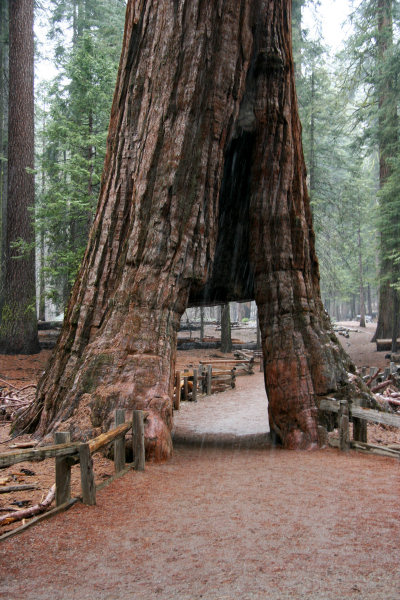 |
| California Tunnel Tree — The footpath passes through the opening cut in 1895. Photo Credit: Yosemite Hikes |
A tunnel was cut through this living sequoia so horse-drawn carriages could pass through. Visitors now walk the same opening. The tree survives, but Yosemite no longer treats excavation as a visitor amenity, which is progress achieved at the pace of a sequoia.
The Faithful Couple
The Faithful Couple began as two sequoias whose trunks fused near the base. The name supplies the romance; the trees supply a more practical demonstration of shared real estate.
Native communities have lived in and around Yosemite for thousands of years and maintain cultural ties to the park. The grove’s human history did not begin with federal protection, wagon roads or people drilling traffic openings through trees.
The Washburn Fire reached the grove in July 2022. Firefighters used sprinklers and other protective measures around major trees, while decades of prescribed fire and fuel work slowed the blaze. No giant sequoias or structures were lost in the grove.
Yosemite by Road: Tunnel View to Tenaya Lake
From Mariposa Grove, we drove Wawona Road to Tunnel View, took the Glacier Point Road out-and-back, then crossed the park on Big Oak Flat Road and Tioga Road. The route linked Yosemite’s famous valley walls with its quieter high country. It also proved that a national park can arrange an entire day around left turns and still make them seem profound.
Tunnel View
 |
| Tunnel View — El Capitan, Half Dome and Bridalveil Fall occupy one sweep of the valley. |
At Tunnel View, El Capitan stands on the left, Bridalveil Fall on the right and Half Dome in the distance. We stayed long enough to watch traffic, clouds and photographers negotiate the same narrow strip of pavement. The granite remained calm throughout.
Glacier Point
 |
| Glacier Point — High Sierra peaks beyond the overlook. |
Glacier Point gives Yosemite’s geography a useful amount of scale. From the railings and short paths, we could trace the valley, the Merced River, Half Dome, Yosemite Falls and the stair-step drop of Nevada and Vernal Falls.
The valley began as a river-cut canyon in uplifted Sierra granite. Repeated glaciations later widened and deepened those older canyons, polished domes and left hanging tributary valleys that now deliver waterfalls over the rim.
 |
| Glacier Point — Nevada Fall above Vernal Fall. |
Glaciers did not create the granite or invent the river system from scratch. They remodeled an existing drainage with the enthusiasm of contractors who had no budget meeting. As the ice withdrew, sediment helped level parts of the valley floor, while rockfalls, streams and the Merced River kept working on the result.
 |
| Glacier Point — Nevada Fall in the distance behind us. |
The Merced begins in Yosemite’s high country, flows through Merced Lake and drops over Nevada and Vernal Falls before entering Yosemite Valley. Yosemite, Bridalveil and Tenaya creeks join the river in or near the valley, arriving rather theatrically over cliffs shaped by the same glacial history.
 |
| Glacier Point — Half Dome and Yosemite Valley behind us. |
West of Yosemite, the Merced runs through the Sierra foothills into Lake McClure and Lake McSwain, then joins the San Joaquin River. The water eventually reaches the Sacramento–San Joaquin Delta and San Francisco Bay. A river that begins among granite peaks ends up negotiating reservoirs, farms, cities and California water policy, which may be the harder terrain.
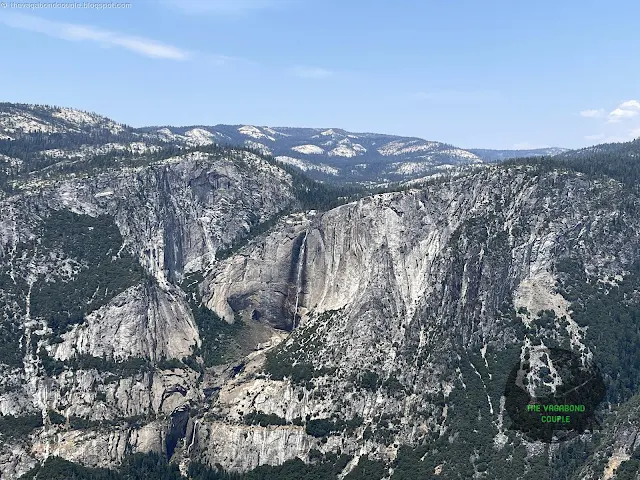 |
| Glacier Point — Yosemite Falls across the north wall of the valley. |
The Glacier Point Geology Hut
The small stone building near the overlook is the Glacier Point Geology Hut. The hut was built in 1925 as an observatory and educational space by the Yosemite Natural History Association. It became the National Park Service’s first trailside museum, placing the lesson beside the evidence rather than making visitors read about cliffs in a room with no cliffs.
 |
| Glacier Point Geology Hut — The 1925 trailside museum beside the overlook. |
Architect Herbert Maier used local stone and the emerging National Park Service Rustic approach, keeping the building low against the much larger architecture outside. Funding came through the Laura Spelman Rockefeller Memorial, and the hut entered the National Register of Historic Places in 1978. The arched openings frame Half Dome and the high country. Yosemite had discovered picture windows before the phrase became a sales feature.
 |
| Inside the Geology Hut — An arched opening frames the high country. |
We sat in the openings, watched the wind move through the valley and understood why the building needed very little decoration. The outside had already overdone it.
Olmsted Point

|
| Olmsted Point — Half Dome across glacially polished granite. |
Olmsted Point sits beside Tioga Road in the high country. From the turnout, Half Dome shows its less familiar northeastern side, while smooth granite slabs carry scratches and scattered boulders left by moving ice. The parking lot supplies the modern layer.
Tenaya Lake
 |
| Tenaya Lake — Granite domes and pine forest reflected in the high-country water. Farwestern Photo by Gregg M. Erickson, CC BY 3.0, via Wikimedia Commons |
Tenaya Lake lies among granite domes beside Tioga Road. We stopped for a picnic beside the clear water. Lafayette Bunnell later recorded Chief Tenaya objecting when the lake was named for him because it already had a name, Py-we-ack. The older name survives nearby in Pywiack Dome.
Back at Tioga Pass
We continued east to Tioga Pass, this time with permission to stop. Ellery Lake and Tioga Lake received a second, less hurried inspection, and the road across the crest made more sense when we were not racing a three-hour pass.
The name Tioga traveled west before the road did. Sierra place-name historian Francis Farquhar traced it to an Iroquois place-name meaning “where it forks,” carried to a mining claim near Mount Dana in 1880.
Watch Shehzadi’s dashcam video as we drive from Tioga Pass back to Oakhurst:
Watch: Driving from Tioga Pass to Oakhurst across Yosemite National Park.
This was the expedition’s sharpest vertical swing: from Furnace Creek below sea level to Tioga Pass at 9,945 feet, then back across the Sierra to Oakhurst. Shehzadi did the climbing; we occupied the seats and took the credit. The route tied together desert geology, film-country boulders, living sequoias and glacier-cut granite in two days without ever leaving California.
Next Stop: Oakhurst to the Grand Canyon via Fresno and Route 66
Back in Oakhurst, Shehzadi’s odometer read 10,704 miles. We were almost halfway around our trans-USA loop. The truck seemed unconcerned. Odometers are excellent at recording consequences and poor at offering opinions.
 |
| Oakhurst — Shehzadi reached 10,704 miles, placing us 4,309 road miles from home in Hyattsville. |
The next leg leaves Oakhurst for Fresno, Bakersfield, Interstate 40 and the South Rim of the Grand Canyon. It also puts Route 66 and two roadside Punjabi dhabas on the same day’s menu. Continue with Part 13, Yosemite to Grand Canyon via Fresno: Mojave Desert, Route 66 and Punjabi Dhabas from California into Arizona.
Reference route map of The Vagabond Couple’s 9,000-mile USA and Mexico overland round trip: Map-1 and Map-2.
- The Vagabond Couple and Shehzadi
