
 |
| Zabriskie Point, Death Valley Morning light picked out the folds and drainage channels in the badlands below the viewpoint. |
Part 10 ended after midnight at The Ranch at Death Valley, with Shehzadi showing 118°F and 10,191 miles after the long run from Nevada. This chapter begins where the Extraterrestrial Highway route through Rachel, Goldfield, Rhyolite and Goldwell finally stopped: below sea level, very late, and with the Toyota Tundra sounding more sensible than its occupants.
Daylight turned Furnace Creek into the base for a circuit through Zabriskie Point, Badwater Basin, Devil's Golf Course, Artists Drive and Golden Canyon. The route kept our walks short, our water close and Shehzadi's air-conditioning employed in a position of considerable authority.
Death Valley Furnace Creek Circuit — Post Summary
From our Furnace Creek base, we drove Shehzadi through Death Valley's eroded badlands, salt pan, volcanic hills and film locations before turning west on CA-190. July 2024 became the park's hottest month on record, so the day favored short walks, frequent retreats to the truck and no arguments with red signs carrying the word STOP. ETR: 16 min.
| What's Covered | |
| 🌅 | Furnace Creek to Zabriskie Point — badlands, heat warnings, film and Pink Floyd |
| 🧂 | Badwater Basin — 282 feet below sea level, salt polygons and Badwater Pool |
| 🧱 | Devil's Golf Course — jagged salt and mud formations |
| 🎨 | Artists Drive and Artists Palette — one-way road through mineral-stained volcanic hills |
| 🌴 | The Ranch and The Inn — shade, palms and Furnace Creek history |
| ⛳ | Furnace Creek Golf Course — a green fairway below sea level |
| 🤖 | Golden Canyon — short heat-limited walk and Star Wars context |
| ⛽ | Furnace Creek Fuel — July 2024 prices and fellow riders |
| 🌡️ | CA-190 westbound — Shehzadi at 129°F and the climb toward Panamint Valley |
We left The Ranch in Shehzadi and made a Furnace Creek circuit before turning west out of the park. Zabriskie Point came first, followed by Badwater Road to Badwater Basin and Devil's Golf Course, the one-way Artists Drive loop, a return through Furnace Creek, a brief Golden Canyon walk, fuel and the climb onto CA-190.
Method: Overland in Shehzadi with brief heat-limited walks
Conditions: July extreme heat; low-elevation walking kept short
Themes: Salt-pan geology · badlands · volcanic colors · film locations
Vehicle: Shehzadi (Toyota Tundra)
Route at a Glance
- Furnace Creek to Zabriskie Point
- Badwater Basin Below Sea Level
- Devil's Golf Course
- Artists Drive and Artists Palette
- The Ranch, The Inn, and Furnace Creek Oasis
- Furnace Creek Golf Course
- Golden Canyon and Star Wars
- Furnace Creek Fuel and Fellow Riders
- CA-190 Westbound at 129°F
Furnace Creek to Zabriskie Point
Death Valley is the hottest, driest and lowest national park in North America, but those three labels flatten a place that is still moving. Basin-and-Range extension began opening Death Valley proper roughly three million years ago. The basin continues to sink while erosion carries rock from the surrounding ranges into it, burying the bedrock beneath thousands of feet of sediment and salts.
The official world heat record recognized by the World Meteorological Organization is an air temperature of 134°F measured at Furnace Creek in 1913. Our visit brought a more immediate statistic: July 2024 became the hottest month recorded in Death Valley, with an average daily high of 121.9°F. The truck readings were not weather-station data, but the warnings around the park needed no embellishment.
That distinction shaped the day. Official records describe conditions measured under controlled standards; Shehzadi described the air around a working pickup on hot pavement. Both numbers mattered for different reasons. The weather record placed our visit inside a rare month. The dashboard told us whether to keep moving, stop briefly or abandon a walk. We treated the truck as transport and a mobile cooling room, not as a substitute weather station.
Nine days earlier, Shehzadi had carried us to Pikes Peak, more than 14,000 feet above sea level. Death Valley would soon reverse that scale at Badwater Basin, turning one expedition week into a vertical argument between a mountain summit and the lowest ground in North America.
 |
| Entering Death Valley The park sign also identifies this country as the homeland of the Timbisha Shoshone. |
The entrance sign added a point the old name can hide: Death Valley is the ancestral homeland of the Timbisha Shoshone. The tribe received federal recognition in 1983, and the Timbisha Shoshone Homeland Act of 2000 established reservation lands and a formal framework for the tribe's continuing relationship with the park. That history belongs beside the geology, not underneath invented legends.
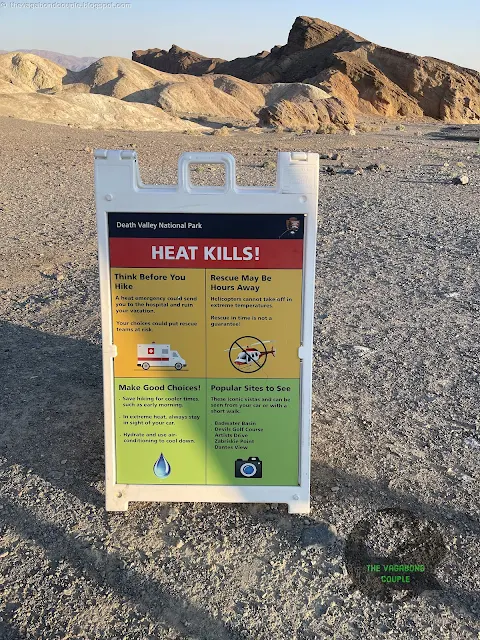
From Furnace Creek, CA-190 climbed east to Zabriskie Point. The short paved walk reached an overlook above yellow and brown badlands, where dry channels folded through deposits laid down in and around ancient Furnace Creek Lake. Water built and later cut this scene. The current dryness is merely the latest management decision by the atmosphere.
The badlands are soft compared with the older mountain rock around them. Rain arrives rarely, but when it does, runoff races over bare surfaces and cuts gullies quickly. That combination creates the tight ridges and branching channels visible from the overlook. The scene looks frozen from a distance, yet every wash records movement. Death Valley does not need frequent water to do serious earthwork; it simply waits and then uses the entire delivery at once.
 |
 |
 |
 |
| Zabriskie Point arrival The roadside sign, a blunt heat warning, and our first close views of the folded badlands. | |||
Zabriskie Point carries the name of Christian Brevoort Zabriskie, a Pacific Coast Borax Company executive. Borax interests helped develop roads, lodging and tourism around Furnace Creek, leaving the viewpoint tied to both geology and the commercial history that made the valley easier to visit.
 |
| Zabriskie Point panorama Water erosion carved the badlands long after the lake sediments beneath them were deposited. |
The wide view showed drainage lines converging below the overlook and darker mountains closing the horizon. A closer frame made the ridges look almost soft, which was a visual trick. The ground was dry, broken and perfectly capable of returning any careless footstep to sender.
Morning light gave the ridges enough shadow to reveal their shape. At midday, the same folds would flatten under harsher light and higher heat. We had arrived early enough to see texture without turning the overlook into a prolonged endurance test. The paved path was short, but even short paths acquire a different personality when every parked vehicle is already warming like an oven with license plates.
 |
| Badlands below Zabriskie Point The ridges appear dry and fixed, yet rare runoff continues to cut their channels. |
The name also carries a second history through Michelangelo Antonioni's 1970 film Zabriskie Point. The film used the viewpoint and CA-190, while Pink Floyd contributed music including “Come In Number 51, Your Time Is Up,” a reworking of “Careful with That Axe, Eugene.” The full movie remains linked here, and the track can be heard through the original music link. Standing above the ridges, the connection felt less like trivia and more like an unusually dusty soundtrack cue.
 |
| Zabriskie Point on film A Blogger-hosted still from Michelangelo Antonioni's 1970 film, retained here as cultural context. |
Badwater Basin Below Sea Level
We returned through Furnace Creek and turned south on Badwater Road. Badwater Basin reversed the scale at 282 feet below sea level, a vertical swing large enough to make the expedition's elevation graph look indecisive.
The parking area sat against the Black Mountains on the east side of the valley. The Panamint Range and Telescope Peak rose across the basin to the west. That orientation matters because the white SEA LEVEL marker is attached high on the Black Mountains behind the parking area—not on cliffs across the salt pan.
 |
 |
||
| Badwater Basin below sea level The elevation sign marked 282 feet below sea level before we stepped onto the bright salt surface. | |||
Badwater occupies the floor of the old Lake Manly system. Water once covered much of the valley, then evaporated and concentrated dissolved minerals. Groundwater still reaches the basin, flows through wet sediment beneath the surface and disappears into the air, leaving salts behind.
The basin floor is the visible top of a much deeper fill. Sediment and salts have accumulated while the valley subsided, so the flat surface hides a long record of erosion from both surrounding ranges. Mountain rock becomes gravel, sand and silt; dissolved minerals move with groundwater; evaporation sorts the result again. Badwater therefore sits at the meeting point of tectonics, erosion, water and heat, an efficient committee whose minutes are written in mud and salt.
 |
| Badwater Basin panorama The salt pan occupies the lowest part of Death Valley, 282 feet below sea level. |
The bright surface was not a perfectly smooth sheet. Salt crust, muddy patches, old footprints and shallow drainage made a changing mosaic across the valley floor. It invited comparison with Salar de Uyuni in Bolivia, though Badwater is smaller, lower and backed by far steeper relief.
The comparison also clarified what photographs can hide. Uyuni can read as a nearly boundless horizontal plane. Badwater sits visibly inside a deep structural basin, with mountain walls defining every direction. The salt did not erase the valley's shape; it emphasized it. White ground, dark rock and a small human figure created a scale that was difficult to fake and even harder to ignore.
Those polygon patterns have a more interesting explanation than “the ground cracked.” Field work published in 2023 linked their regular scale to salinity-driven convection in wet porous sediment below the crust. Denser, saltier water sinks while fresher water rises, organizing subsurface circulation into cells that correspond broadly with the polygons visible at the surface. The basin was quietly doing fluid dynamics while we were concentrating on not frying.
Badwater Pool is spring-fed and saline. The National Park Service notes that an endemic snail lives there, a small biological rebuke to any claim that the basin is lifeless. Stories connect the name “Badwater” to a surveyor's mule refusing to drink, which was a sound decision by the mule and an efficient contribution to American place-naming.
 |
 |
 |
 |
 |
 |
||
| Badwater salt, pool, and sea-level markers Salt crust, the spring-fed pool, and two views of the marker fixed high on the Black Mountains east of the basin. | |||
The two marker photographs show why 282 feet can be hard to grasp. Sea level appeared as a small sign high above the parking area, while the salt pan spread across the floor below. The valley turned an abstract contour line into something that could look down on us.
We kept the walk modest. The white surface reflected light, the surrounding rock stored heat and the return distance grew with every step away from the boardwalk. Badwater offered no shade and very little ambiguity. A short visit still gave us the basin's scale, the salt texture, the pool and the marker; extending it in July would mostly have added risk and a longer retreat.
Devil's Golf Course
A rough dirt spur left Badwater Road for Devil's Golf Course. This part of the basin preserves a much rougher salt surface than the walking area at Badwater. Evaporation, wind and occasional rain shape the salt-and-mud deposits into sharp knobs, ridges and cavities.
The name came from an old guidebook observation that only the devil could play golf there. The surface supported the joke. We stayed on the established approach and treated the formations as geology rather than sporting equipment; falling onto them would have turned a clever place name into paperwork.
Up close, the formations were less like clean crystals and more like a hardened jumble of salt, clay and sharp cavities. Shadows collected inside small openings while the exposed ridges flashed white. The roughness also explained why the site differs so strongly from the walked salt pan at Badwater. Both belong to the same basin, but water, sediment and erosion have produced very different surfaces within a few miles.
 |
 |
 |
 |
| Devil's Golf Course A rough field of salt and mud crystals where even a careful step required negotiation. | |||
In the heat, we heard faint pops and cracks among the salt. We kept that as an observed sound rather than assigning it a neat mechanism. Death Valley already had enough verified processes without asking us to diagnose every noise from a parking area.
Artists Drive and Artists Palette
Back on Badwater Road, we entered Artists Drive, a nine-mile one-way loop through the Black Mountains. The road is narrow, twisting and limited to vehicles no longer than 25 feet. Shehzadi fitted. Larger rigs need to admire it through other people's photographs, which is less satisfying but cheaper than becoming a permanent road feature.
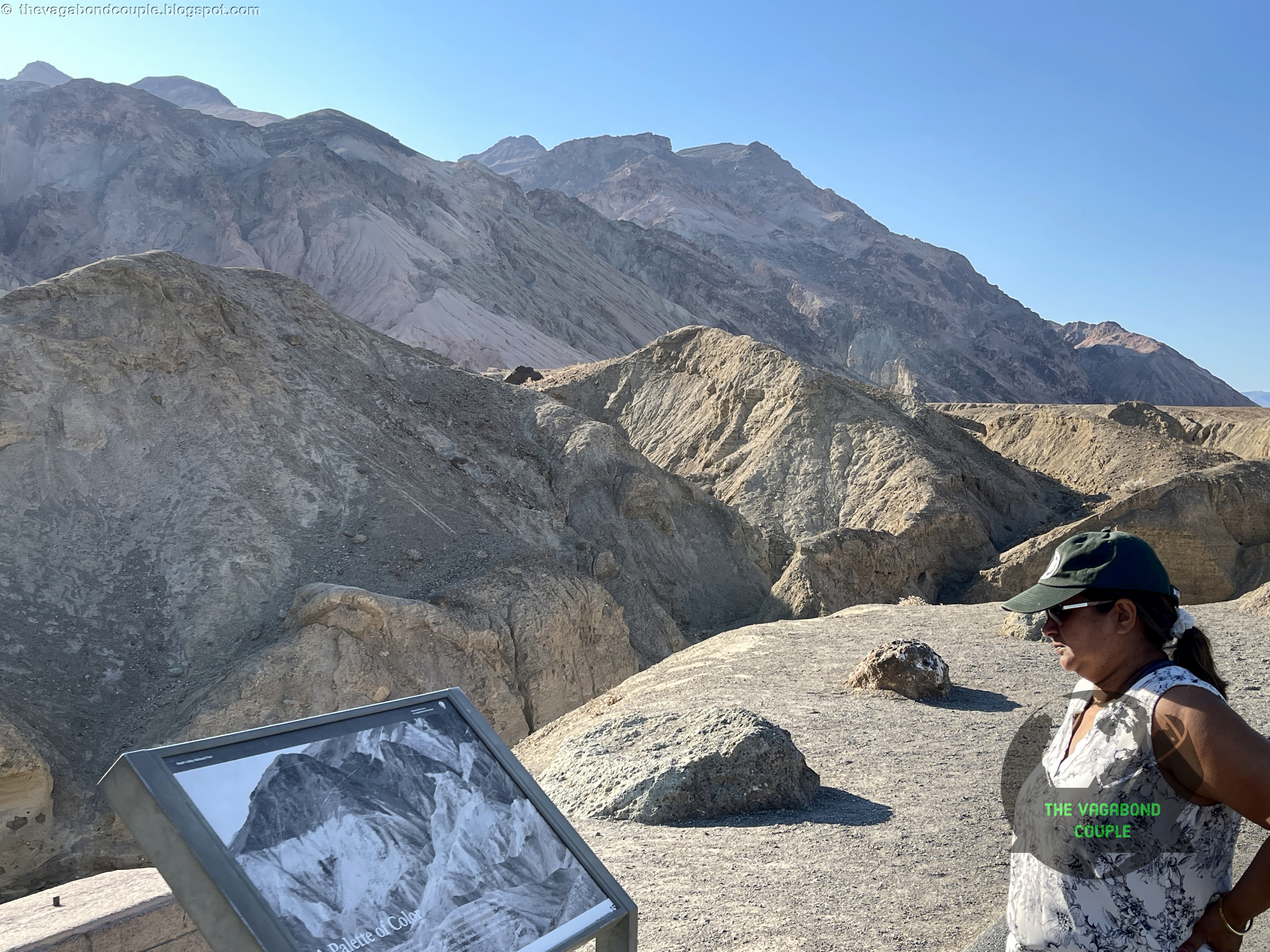
The route rose into volcanic deposits stained green, pink, yellow, tan and red. Iron oxides contribute reds and yellows, while chlorite and related compounds help produce green tones. Different layers weather at different rates, so the colors appeared in bands, patches and folded slopes rather than in one tidy painter's tray.
 |
 |
 |
 |
 |
 |
||
| Artists Drive and Artists Palette The one-way road climbed into mineral-stained volcanic deposits before curling back toward Badwater Road. | |||
Artists Palette held the strongest concentration of color, but the drive mattered as much as the pullout. The road narrowed between eroded walls, climbed, dipped and turned back toward the valley floor. From inside the Tundra, the sequence moved from colored rock at arm's length to broad views across Badwater and the Panamint Range.
The one-way rule removed oncoming traffic from the narrowest bends, though it did not make the road wide. Shehzadi filled much of the lane and made every pullout feel carefully rationed. The high hood framed each rise before the road dropped away again. This was a slow drive by design, which suited both the geology and the temperature: stop briefly, photograph, return to the cab and let the road deliver the next angle.
Our complete dashcam sequence preserves that road movement better than still photographs can. It follows Artists Drive from the palette area toward the return to Badwater Road.
Watch: Driving Artists Drive from Artists Palette toward Badwater Road in Death Valley National Park.
Updated August 2026: Artists Drive remains a one-way route with a 25-foot vehicle limit. Park roads can close after storms or repair work, so the official NPS road-status map should be checked immediately before travel.
The Ranch, The Inn, and Furnace Creek Oasis
Furnace Creek placed palms, buildings, pools and shaded porches against a basin famous for removing moisture from nearly everything. The contrast was practical rather than magical. Springs and managed water supported the settlement, while tourism infrastructure grew from the borax era into the present resort complex.
Pacific Coast Borax built the Furnace Creek Inn in 1927 as tourism became part of the case for protecting Death Valley. The present Inn at Death Valley retains Mission- and Spanish-influenced architecture, stone lower levels, palms and a spring-fed pool. That documented history replaced the source's unsupported claim that the photographed stone passage was a mining tunnel.
The Inn's height above the valley floor changed the view more than the map suggested. From the terrace, palms and walls occupied the foreground while the open basin and mountain ranges spread beyond them. The stone passage felt cool and enclosed, but its value came from that physical contrast rather than an invented mining biography. Sometimes a corridor is allowed to be a corridor, even in a valley with plenty of actual mines.
 |
 |
||
| Cooling down in Furnace Creek Misters at The Ranch and a stone-lined passage at The Inn offered two very different forms of shade. | |||
The Ranch and The Inn served different moods. The Ranch supplied practical relief: food, rooms, a store and cooling misters. The Inn sat higher, with shaded terraces looking across the basin. We moved between them with the gratitude normally reserved for functioning air-conditioning and reliable ice.
Furnace Creek Golf Course
The final terrace views led toward one of Furnace Creek's stranger pieces of green infrastructure. Furnace Creek Golf Course lies about 214 feet below sea level and is documented as the world's lowest golf course. We visited the fairway but did not play a round. July had already introduced enough extreme sports through ordinary walking.
 |
 |
 |
 |
| The Inn terrace and Furnace Creek Golf Course Palms and shaded terraces overlooked the basin, while a green fairway occupied ground about 214 feet below sea level. | |||
The course made the oasis visible at scale: irrigated grass, palms and buildings compressed into a narrow inhabited zone, with bare mountains and salt flats immediately beyond. It was an engineered patch of green, not evidence that Death Valley had softened its position.
The fairway also made elevation feel odd in a different way from Badwater. Golf courses usually suggest drainage toward some lower place. Here, the course already sat below sea level, and the mountains still rose abruptly around it. We looked, photographed and declined to test whether a golf ball travels differently when the golfer is pre-cooked.
Golden Canyon and Star Wars
Golden Canyon Trailhead sat south of Furnace Creek along Badwater Road. We entered the canyon briefly, enough to pass between yellow walls and see the wash narrow. The time of day and the posted heat warning ruled out the longer route toward Red Cathedral and Gower Gulch.
 |
 |
||
| Inside Golden Canyon We walked a short distance into the yellow canyon walls before the heat ended the discussion. | |||
The stop also carried a film connection. Death Valley locations appear in the original Star Wars films, where the park's canyons and open desert helped represent Tatooine. Golden Canyon and nearby terrain are part of that wider filming geography. We retained the film still as a reference without claiming that our exact frame matched one precise R2-D2 scene.
The canyon walls made the association easy to understand. Yellow rock closed around a dry wash, side channels disappeared between ridges and almost no vegetation interrupted the frame. The effect came from real erosion rather than set construction. Hollywood needed a desert planet; Death Valley already had the geology and required only cameras, actors and considerably more sensible catering.
 |
| Star Wars in Death Valley A Blogger-hosted film still from Star Wars: A New Hope, retained as a visual reference to the park's filming history. |
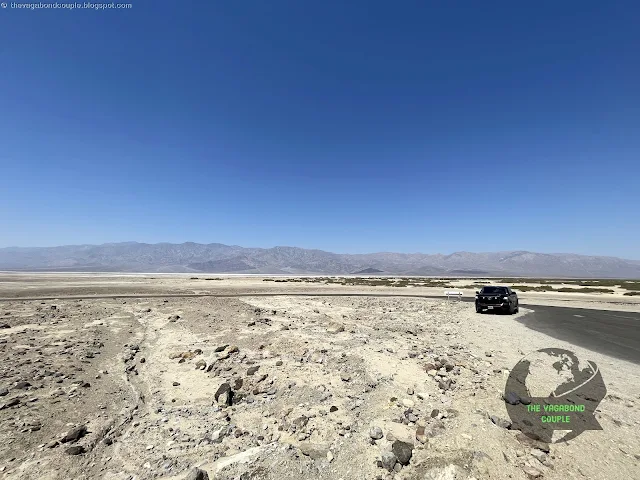
The red STOP-shaped sign at the trailhead made the practical decision for us: “Extreme Heat Danger,” with walking after 10 a.m. not recommended. This was not a suggestion printed in a polite font. We turned back toward the parking area and the comfortable bowels of Shehzadi.
 |
 |
 |
|
| Golden Canyon turnaround The STOP-shaped danger sign, the open trailhead, and Shehzadi waiting with functioning air-conditioning. | |||
That retreat was part of the visit, not a failed hike. In July, deciding where not to walk can be the most useful route choice of the day.
Furnace Creek Fuel and Fellow Riders
Furnace Creek Fuel provided the last practical stop before our westbound departure. The price board in the photograph is historical evidence from the morning of July 11, 2024, not a promise to future wallets. Fuel in the middle of Death Valley costs what fuel in the middle of Death Valley thinks it costs.
At the station, we met motorcyclists wearing Ukraine HOG chapter patches. The photograph records the group, their motorcycles and our brief roadside meeting. We did not turn the patches into biographies, but the encounter mattered: riders from overseas had brought Harley culture into one of the hottest road environments in North America.
Motorcycles removed the layer of glass, insulation and refrigerated air that made Shehzadi comfortable. The riders' presence sharpened our respect for their route without requiring us to invent their story. We shared a fuel stop, patches, machines and the common arithmetic of distance between services. On this road, that was enough introduction.
 |
 |
 |
|
| Furnace Creek services and road company July 2024 fuel prices, riders wearing Ukraine HOG patches, and the CA-190 sign that pointed us toward the next leg. | |||
Updated August 2026: NPS currently lists around-the-clock gas at Furnace Creek and Stovepipe Wells, with more limited hours at Panamint Springs. Availability can change, so fuel should still be treated as a route constraint rather than a birthright.
CA-190 Westbound at 129°F
We left Furnace Creek on CA-190. Shehzadi's outside-temperature sensor briefly reported 130°F while we were moving. By the time we stopped, the display showed 129°F at 20:26 with 10,256 miles on the odometer. The number was a vehicle-sensor reading affected by road heat and operating conditions, not an official park observation, but it was quite sufficient for a pickup truck to make its point.
 |
| Shehzadi at 129°F The truck display showed 129°F, 20:26, and 10,256 miles. The sensor had briefly reported 130°F before we stopped. |
The odometer also corrected another easy mistake. Shehzadi had accumulated 3,861 miles since leaving Hyattsville; we were not 3,861 miles away in a straight line. Road distance and displacement had parted company somewhere around the first mountain range and were no longer speaking.
CA-190 does not run through Badwater Basin or Artists Palette. Those stops required Badwater Road and Artists Drive. The highway instead carried us west from Furnace Creek, across the basin and toward the climb over the Panamint Range, where Part 12 would continue toward Panamint Valley and the Eastern Sierra.
The westbound road began by crossing open ground, then aimed toward darker slopes. Distance distorted speed: the mountains appeared close, the road ran straight at them and several miles passed before the grade made any serious claim on the truck. As elevation increased, the basin widened behind us. Furnace Creek shrank into a small green interruption, and the white floor became one pale band among many.
The climb also marked the practical end of our Furnace Creek circuit. Every stop from Zabriskie Point to Golden Canyon remained behind the same basin, but the road ahead belonged to a different chapter. CA-190 would cross higher country, drop into Panamint Valley and carry us toward the Sierra Nevada. Death Valley had not ended at one sign; it ended gradually, one grade and one cooling degree at a time.
 |
 |
 |
 |
| Westbound on CA-190 Shehzadi climbed away from the Furnace Creek basin as the road threaded through bare slopes toward Panamint Valley. | |||
Death Valley compressed a remarkable amount of physical scale into one circuit: eroded lake deposits at Zabriskie Point, the floor of an ancient lake at Badwater, rough salt at Devil's Golf Course, volcanic colors on Artists Drive and an inhabited spring-fed pocket at Furnace Creek. Heat limited what we could do, but it also clarified the route. We stopped, looked, retreated and let Shehzadi carry the longer distances.
The circuit also made the park's road pattern easier to understand. Furnace Creek acted as the hinge. CA-190 reached Zabriskie Point and carried us out; Badwater Road reached the lowest ground; Artists Drive looped through the Black Mountains; Golden Canyon sat between the oasis and the southern salt-pan route. None of those roads was interchangeable, and July left little room for casual detours. Planning the sequence mattered as much as choosing the stops. It also kept every retreat pointed toward fuel, shade or the next paved exit, which in Death Valley is a route-planning philosophy worth keeping on every remote western desert road.
The salt offered another callback to the Andes Altiplano and Salar de Uyuni, but the comparison ended at evaporation and white ground. Death Valley paired its salt with a 282-foot depression, steep ranges and heat that followed the truck well into evening.
Next Stop
Part 12 begins exactly where this post ends: westbound on CA-190. Shehzadi climbs out through Panamint Valley, reaches Lone Pine and the Eastern Sierra, then crosses Tioga Pass into Yosemite in From Death Valley into Yosemite via the Eastern Sierra and Tioga Pass.
Reference route map of The Vagabond Couple's 9,000-mile USA and Mexico overland roundtrip: Map-1 and Map-2.
— The Vagabond Couple and Shehzadi
