
 |
| A framed 2019 Scott Boudin Festival poster at Fezzo's, using Scott's official “Boudin Capital of the World” title. |
Part 19 ended on the San Antonio River Walk, where a proper hotel bed felt almost suspicious after the Terlingua cabin. The next morning, Shehzadi—our Toyota Tundra—was waiting in the garage for the road east. The previous leg carried us from Terlingua Ranch to San Antonio via Langtry and Junction.
Our route to Lafayette stayed mostly on Interstate 10: Schulenburg, Houston, Beaumont, Pinehurst, Lake Charles, then an overnight in Lafayette and dinner next door in Scott. The highway looked uncomplicated on the map. Houston would soon file an objection.
Trans-America Overland Part 20 — Post Summary
This leg of our Trans-America route leaves San Antonio on I-10, pauses in Schulenburg, threads Houston traffic, stops in Beaumont for Spindletop history, crosses into Louisiana past Lake Charles, and ends with an overnight in Lafayette and dinner in neighboring Scott, where boudin gets considerably more serious.
| What's Covered | |
| 🚂 | Schulenburg Railroad Town and Central European Texas — railroad stop and German, Austrian and Czech settlement context |
| 🚙 | Houston on Interstate 10 at Rush Hour — evening traffic through the Houston metro |
| 🛢️ | Beaumont and the Spindletop Oil Boom — Spindletop, Jefferson Theatre and petroleum-era history |
| 🛣️ | Louisiana State Line to Lafayette via Lake Charles — Pinehurst, the state line and the I-10 run across southwest Louisiana |
| 🎶 | Lafayette and Acadian-Cajun Louisiana — Acadian history and South Louisiana cultural context |
| 🍽️ | Boudin and Dinner in Scott, Louisiana — Fezzo's oysters, alligator, boudin balls and chicken-and-sausage gumbo |
| ➡️ | Next Stop — Baton Rouge, the Mississippi and New Orleans in Part 21 |
We left San Antonio in Shehzadi, our Toyota Tundra, and followed Interstate 10 east toward Lafayette, Louisiana. The route ran through Schulenburg, Houston and Beaumont before crossing the state line just beyond Pinehurst, then continued past Lake Charles to Lafayette and neighboring Scott. The highway itself was simple. The cultural handoff was not.
Method: Overland by truck on Interstate 10
Distance / Time: One travel day
Themes: Central European Texas heritage · Spindletop oil history · Cajun foodways
Vehicle: Shehzadi (2024 Toyota Tundra)
Route at a Glance
- Schulenburg — roadside stop in a railroad town shaped by Central European immigration
- Houston — Interstate 10 through evening rush-hour traffic
- Beaumont — twilight stop with Spindletop and downtown history
- Pinehurst to Lake Charles — Texas-Louisiana state-line crossing on Interstate 10
- Lafayette — overnight in South Louisiana and Acadian-Cajun context
- Scott — dinner at Fezzo's, with oysters, alligator, boudin and gumbo
Schulenburg Railroad Town and Central European Texas
Schulenburg was our first pause. We saw the town's German-language cues before we knew much of the history: wurst, bier, a sausage billboard and a roadside church that had us reaching for the camera. We grabbed a quick snack and stretched our legs.
 |
| Schulenburg, Texas, on the I-10 run east from San Antonio. |
Schulenburg exists because of rails, not because somebody dropped a Bavarian village beside I-10. The town took shape in 1873 when the Galveston, Harrisburg and San Antonio Railway reached the site. The wider Fayette County area had already drawn German, Austrian and Czech settlers, and that Central European imprint survived in local music, dance halls and the painted churches scattered around the countryside. We only stopped briefly, but the roadside church and the town sign made more sense with that history behind them. Texas can fit a remarkable amount of Europe between two freeway exits.
Houston on Interstate 10 at Rush Hour
Then I-10 fed us into Houston around 5:30 PM, exactly when half the metropolitan area appeared to have made the same appointment. A full-size Tundra with Maryland plates, frontage roads, merging freeways and semis made for a concentrated driving session.
Shehzadi handled the lane changes without drama; we supplied the sweat. Once the skyline began shrinking in the mirrors, the road became less theatrical again, with Beaumont next.
Beaumont and the Spindletop Oil Boom
Beaumont arrived at twilight, and after Houston it felt pleasantly manageable. We stopped long enough to let ourselves and Shehzadi cool down, then looked around downtown and admired the Jefferson Theatre.
Beaumont's oil story needs very little salesmanship. On January 10, 1901, the Lucas Gusher at Spindletop blew in south of town at about 100,000 barrels a day.
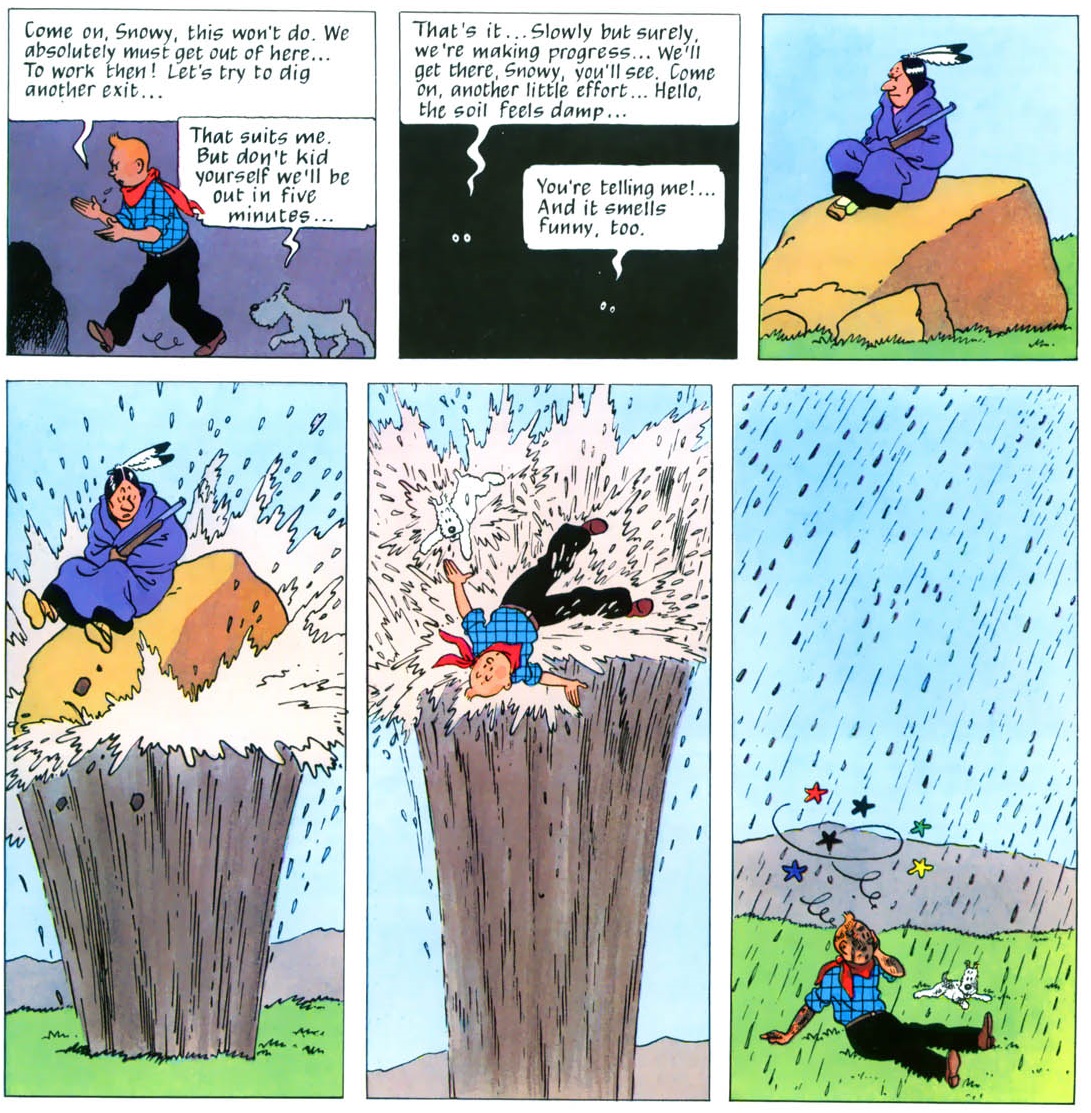 |
| Hergé's Tintin in America turns an oil strike into speculation and forced displacement at comic-strip speed. |
Hergé gave American oil development fewer committee meetings. In Tintin in America, Tintin accidentally releases an oil gusher, and within a few panels businessmen, settlers and the army arrive. Hergé plays the speed for satire, then makes the joke darker by showing Native people pushed off the land. Spindletop was real rather than comic-book physics, but Beaumont changed fast enough after the strike that the caricature feels less absurd than it should.
Spindletop became the first important Gulf Coast oil well, and the production that followed helped turn Beaumont and the Sabine district into a major refining and export center. The discovery also kicked off a wider oil boom across Southeast Texas. Our twilight stop was quieter. Oil had already supplied the drama.
Louisiana State Line to Lafayette via Lake Charles
East of Beaumont we passed Pinehurst and soon crossed into Louisiana. The drive looked wetter and greener as we continued toward Lake Charles, and the radio added zydeco to the handoff. State lines do not usually come with a soundtrack. This one did.
Lake Charles came and went in casino lights. Night was settling in by the time we continued east to Lafayette.
Lafayette and Acadian-Cajun Louisiana
Lafayette was our overnight base, with dinner still ahead a few miles west in Scott. The Acadian history of South Louisiana had followed a much less direct route than a map might suggest.
British authorities began deporting Acadians from their homeland in 1755, and the removals continued for years, scattering families around the Atlantic world. Some later reached South Louisiana. There they adapted to new environments and lived alongside American Indians, free people of color, enslaved Africans and their descendants, and immigrants from several parts of the world. Louisiana's own folklife program describes the region as a complex cultural mix. Cajun French, music, food and architecture changed here because culture travels with luggage and then ignores the packing list.
Boudin and Dinner in Scott, Louisiana
Dinner pulled us a few miles west to Scott and Fezzo's, which several locals had recommended. The illuminated sign was easy to spot. Hunger remains a dependable navigation system.
 |
| Fezzo's Seafood, Steakhouse & Oyster Bar in Scott, Louisiana. |
Scott has an unusually official relationship with sausage. In 2012, the Louisiana Legislature designated the city the “Boudin Capital of the World.” The inaugural Scott Boudin Festival followed in 2013. Louisiana foodway sources describe boudin as a fresh pork-and-rice sausage, commonly seasoned with onion and other ingredients; recipes vary, and liver is common in some versions rather than compulsory in all of them. Our plate at Fezzo's included fried boudin balls rather than a cased link. There is no boudin police, although the legislature came surprisingly close.
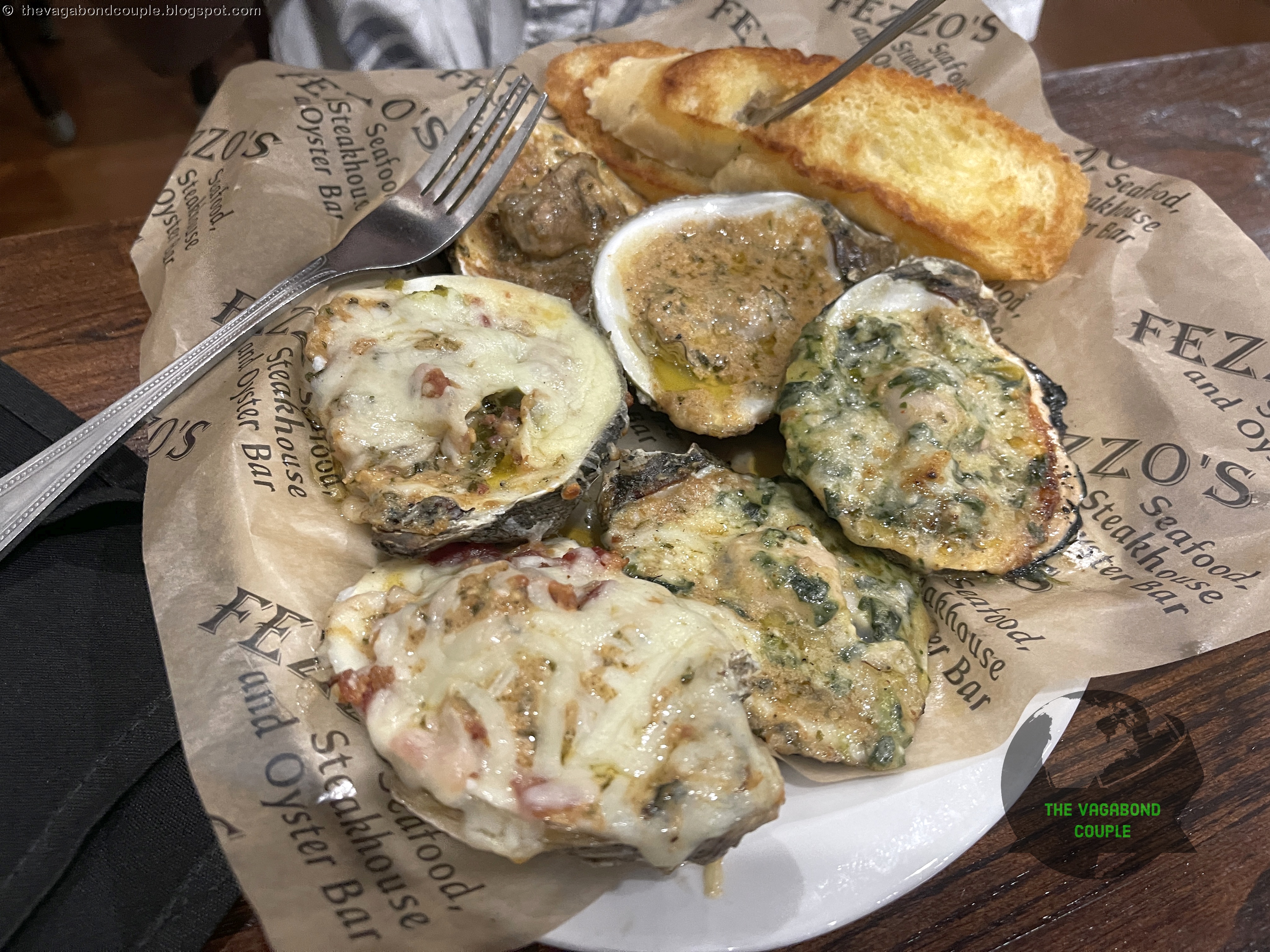 |
| Fezzo's oyster sampler. |
We started with the oyster sampler, six prepared oysters with different toppings. It was a useful opening argument for staying awhile.
 |
| Fried alligator bites at Fezzo's. |
The fried alligator bites were mild and firm, landing somewhere between chicken and catfish to us. Alligator remains stubbornly uninterested in fitting a normal menu category.
 |
| Fried boudin balls at Fezzo's. |
Then came the fried boudin balls. Pork, rice, seasoning and a fried crust made them compact, rich and very easy to underestimate until the plate started disappearing.
 |
| Chicken-and-sausage gumbo at Fezzo's. |
The gumbo was chicken and sausage, served in a dark roux with rice. It was rich enough that our earlier plan to “just try a few things” had become a historical document.
We left Fezzo's full, drove back to our Lafayette hotel and called it a night. The spices on our hands lingered longer than our ambition to stay awake.
Before we closed the day, the dashboard supplied one more number.
 |
| Shehzadi's dashboard at the end of Part 20 in Lafayette, Louisiana. |
By the time we parked for the night in Lafayette, Shehzadi's odometer read 14,041 miles. That put 7,646 miles of this Trans-America loop behind us since Hyattsville, Maryland. The day had run from San Antonio through Schulenburg, Houston and Beaumont, crossed one state line, and ended with boudin in Scott. Interstate 10 had handled most of the navigation. The rest was a useful reminder that a highway number tells us almost nothing about what waits at the exits.
Next Stop — Baton Rouge, the Mississippi and New Orleans
The next morning, I-10 would carry us east again to Baton Rouge for lunch by the Mississippi River, our first reunion with the river since St. Louis. After that came New Orleans, with a hotel near the streetcar stop at St. Charles Avenue and Euterpe Street.
Part 21 picks up that drive from Lafayette through Baton Rouge to New Orleans in NOLA Calling — Lafayette to New Orleans via Baton Rouge.
Our reference maps for the 9,000-mile USA and Mexico overland roundtrip are Map-1 and Map-2.
Until next time,
- The Vagabond Couple and Shehzadi
