
 |
| Bryce Amphitheater from Sunrise Point, where the hoodoos began the day with considerably more composure than we did. |
Part 6 carried us from Moab through Red Canyon, Kodachrome Basin, Grosvenor Arch, and Grand Staircase-Escalante before setting us down in Kanab. That full approach is in our Moab-to-Kanab overland chapter, where Utah had already used enough rock formations for several respectable planets.
This Part 7 sent Shehzadi, our 2024 Toyota Tundra, north to Bryce Canyon before we doubled back for Coral Pink Sand Dunes, the Kanab Sand Caves, the Zion-Mount Carmel Highway, Hurricane, and St. George. The odometer added 278 miles. The day added two national-park corridors, one former sand mine, and enough loose sand to follow us into the truck without being invited.
Trans-America Overland Part 7 — Post Summary
This Utah overland chapter runs from Kanab to St. George through Red Canyon and Bryce Canyon National Park, then returns south by Coral Pink Sand Dunes and the former Kanab sand mine before crossing the Zion-Mount Carmel Highway to Hurricane and St. George.
| What's Covered | |
| 🪨 | Red Canyon — Scenic Byway 12 and its historic roadway portals |
| 🌅 | Bryce Canyon entrance and Sunrise Point — park history, hoodoos, and Queen's Garden Trail |
| 🥾 | Sunset Point and Navajo Loop — switchbacks beneath the rim |
| 🔭 | Inspiration Point, Bryce Point, and Paria View — the southern overlooks |
| 🏜️ | Coral Pink Sand Dunes — wind-built dunes and an endemic tiger beetle |
| ⛏️ | Kanab Sand Caves — a short scramble to a former glass-sand mine |
| 🛣️ | Zion-Mount Carmel Highway — switchbacks and the 1.1-mile tunnel |
| 🌮 | Hurricane — lunch, local pronunciation, and Mexican Revolution posters |
| 🌡️ | St. George — Cotton Mission history, 113-degree heat, and the final odometer |
We rolled out of Kanab early and aimed north on US Highway 89, then turned onto Scenic Byway 12 for Red Canyon and Bryce Canyon. The return leg brought us south again by way of the dunes and the Sand Caves before Utah State Route 9 carried us through Zion to Hurricane and St. George. It was a large loop for one day, but Shehzadi has never regarded maps as binding arbitration.
Method: Overland by truck
Distance / Time: Approx. 278 miles / 1 day
Themes: Hoodoo geology · trail hiking · road engineering
Vehicle: Shehzadi (2024 Toyota Tundra)
Route at a Glance
- Kanab to Red Canyon — north on US 89 and east on Scenic Byway 12
- Bryce Canyon entrance and Sunrise Point — first rim views and Queen's Garden Trail
- Sunset Point and Navajo Loop — below-rim switchbacks through the hoodoos
- Inspiration Point, Bryce Point, and Paria View — the southern overlook sequence
- Coral Pink Sand Dunes State Park — southbound return to the dune field
- Kanab Sand Caves — short hike and sandstone scramble to the former mine
- Zion-Mount Carmel Highway — west through Zion's tunnel and switchbacks
- Hurricane — lunch and a roomful of Mexican Revolution history
- St. George — overnight stop after 278 miles
Red Canyon and Scenic Byway 12
Red Canyon appeared before Bryce had a chance to claim the morning. We stopped beside the Dixie National Forest sign, where orange hoodoos crowded the road and pine trees occupied whatever ground the rock had neglected. This was our second pass through Red Canyon, but the light had moved and the formations had rearranged the shadows. Geology is very good at appearing busy while taking several million years to finish anything.
 |
| Shehzadi at the Dixie National Forest sign near Red Canyon. |
Scenic Byway 12 threads through the western edge of the Claron Formation, the same broad package of sedimentary rock that supplies Bryce Canyon with its hoodoos. Iron minerals help produce the orange and red tones. Frost, runoff, and gravity do the editing, slowly removing the softer material and leaving increasingly improbable shapes behind.
 |
| Red Canyon hoodoos beside Scenic Byway 12, with Shehzadi doing the useful work of providing scale. |
The two openings across the highway are commonly called the Red Canyon Arches, though they function as roadway portals. They marked the 1925 entrance to what was then Utah National Park, the short-lived federal name used before Bryce Canyon received its permanent title. The road now passes directly beneath both, which is scenic, historic, and a minor test of whether every roof box was tightened properly.
 |
| The first Red Canyon roadway portal on Scenic Byway 12. |
A century of traffic has not been entirely polite. Utah transportation engineers monitor cracks, rock movement, and collision damage with sensors, drones, and laser scans. Parts of the portals have also received sprayed concrete reinforcement. The result remains visually convincing, provided nobody asks the road cut to produce its birth certificate.
 |
| The second Red Canyon roadway portal, another century-old hole through a very solid argument. |
Bryce Canyon Entrance and Sunrise Point
Ebenezer Bryce arrived in the area with his family in 1875, and local use of the name Bryce Canyon followed. Federal protection came later: a national monument in 1923 and Bryce Canyon National Park in 1928. The park is not a single canyon in the usual river-cut sense. It is a chain of eroded amphitheaters along the Paunsaugunt Plateau, which is an efficient way for a map to say the edge has been falling apart beautifully.
 |
| Arrival at Bryce Canyon National Park. |
At the parking area, a Swiss-plated campervan supplied an immediate overland conversation. Its owners were unloading bicycles after shipping the vehicle from Europe. We had met another version of the same idea: move the vehicle across the inconvenient water, then resume the road as if the ocean had merely been an expensive ferry lane.
 |
| A Swiss-plated campervan at Bryce Canyon while its owners unloaded bicycles. |
Sunrise Point opened over Bryce Amphitheater in ranks of fins, spires, and hoodoos. Southern Paiute tradition, as recorded by the National Park Service, describes these forms as Legend People turned to stone after wrongdoing. The account gives the formations moral weight as well as shape; the rim was not empty country waiting for a park brochure to discover it.
 |
| Sunrise Point above Bryce Amphitheater. |
The hoodoos rise from the Claron Formation. Water enters cracks, freezes, expands, and pries the rock apart, while rain and runoff carry loosened material downslope. Repeated freeze-thaw cycles leave narrow walls, then windows, then freestanding towers. Bryce makes erosion look like sculpture, although the sculptor has no deadline and very poor respect for railings.
 |
| Bryce Amphitheater spread below Sunrise Point. |
Later, during our three-continent Silk Road expedition, Shehzadi reached Cappadocia and its fairy-chimney country. Bryce used limestone, frost, and runoff; Cappadocia used volcanic tuff, wind, water, and centuries of human carving. Two distant provinces had independently reached the conclusion that ordinary rock was insufficiently eccentric.
 |
| The Queen's Garden Trail dropping from Sunrise Point among the hoodoos. |
The Queen's Garden Trail descends from Sunrise Point into the amphitheater. The full Queen's Garden and Navajo combination covers 2.9 miles, but even the opening descent changes the scale immediately. From the rim, the hoodoos resemble a crowded stone city. On the trail, they become walls and passageways, and the convenient overview disappears behind the next bend.
 |
| Layered hoodoos and forested ridges below Sunrise Point. |
Sunset Point and the Navajo Loop Trail
We continued along the rim to Sunset Point, where the Navajo Loop begins. Thor's Hammer stands below the overlook, top-heavy and apparently untroubled by physics. The loop drops through two branches, Wall Street and Two Bridges, between narrow limestone walls and tall Douglas firs. The official name is well established; the source of that name is not clearly documented, so the trail was allowed to remain a trail rather than become an amateur etymology seminar.
 |
| Sunset Point above the Bryce Amphitheater. |
The switchbacks folded sharply below us. They made the descent look compact from above, which is one of the more successful optical deceptions in national-park planning. Each turn surrendered elevation quickly, and the rim began to rise behind us.
 |
| The Navajo Loop switchbacks below Sunset Point. |
Inside the amphitheater, the rock changed from a distant skyline into close walls striped with iron-rich bands. The Claron Formation records ancient lakes and floodplains, then a much later history of uplift and erosion. The result was underfoot, overhead, and occasionally close enough to remove the need for peripheral vision.
 |
| Descending the Navajo Loop between walls of the Claron Formation. |
A small window opened through one wall beside the trail. Such openings are temporary stages in hoodoo formation: erosion cuts through a fin, enlarges the hole, and eventually separates the remaining columns. “Temporary” is doing patient work here. The rock has a somewhat broader definition of soon.
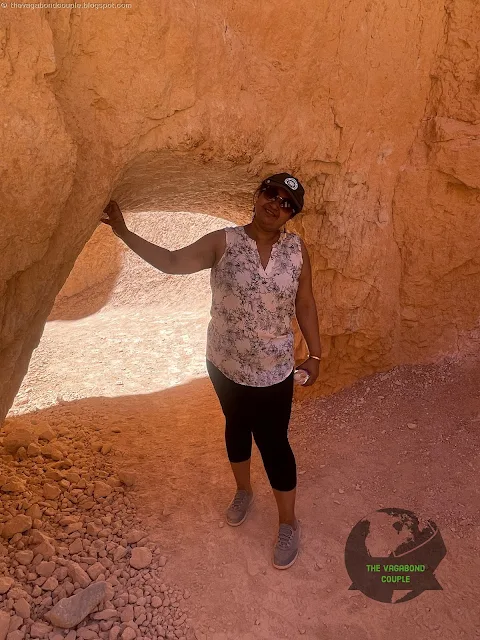 |
| A small rock window along the Navajo Loop Trail. |
The narrow passages held cooler air and muted the open-rim glare. Footsteps, voices, and the scrape of shoes against loose grit replaced the broad silence above. Bryce from the rim was a pattern. Bryce below the rim was a route that demanded attention one turn at a time.
 |
| A narrow passage on the Navajo Loop Trail. |
We walked back through the orange corridor with the switchbacks now above us. The Navajo Loop made the day physical rather than merely scenic, which was useful. A road trip can otherwise persuade the legs that their only constitutional duty is operating pedals.
 |
| Walking through the orange-rock corridor of the Navajo Loop. |
Inspiration Point, Bryce Point, and Paria View
Back in Shehzadi, we followed the park road south through the overlook sequence. Inspiration Point stands above a dense part of Bryce Amphitheater at roughly 8,100 feet. The higher angle compresses the hoodoos into tight rows, with forest occupying the gullies between them.
 |
| Inspiration Point at 8,100 feet. |
From here, the amphitheater looked less like scattered formations and more like an entire stone district. The Silent City name fits the clustering, though the place was not silent in any absolute sense. Wind moved through the pines, cameras clicked, and everyone near the railing negotiated privately with the idea of dropping a phone.
 |
| The dense hoodoos of Bryce Amphitheater from Inspiration Point. |
We stayed long enough for the light to shift across the upper walls. Small changes in angle moved the strongest orange tones from one ridge to another. The rock did not change color so much as reveal which surfaces had been waiting for their turn.
 |
| At Inspiration Point with the amphitheater behind us. |
Bryce Point came next at roughly 8,300 feet. The overlook projects farther into the amphitheater and gives a broad view north across the main hoodoo basins. This was the highest named stop on our short overlook run, and Shehzadi handled the climb with the calm of a truck that had not been asked to walk back up the Navajo Loop.
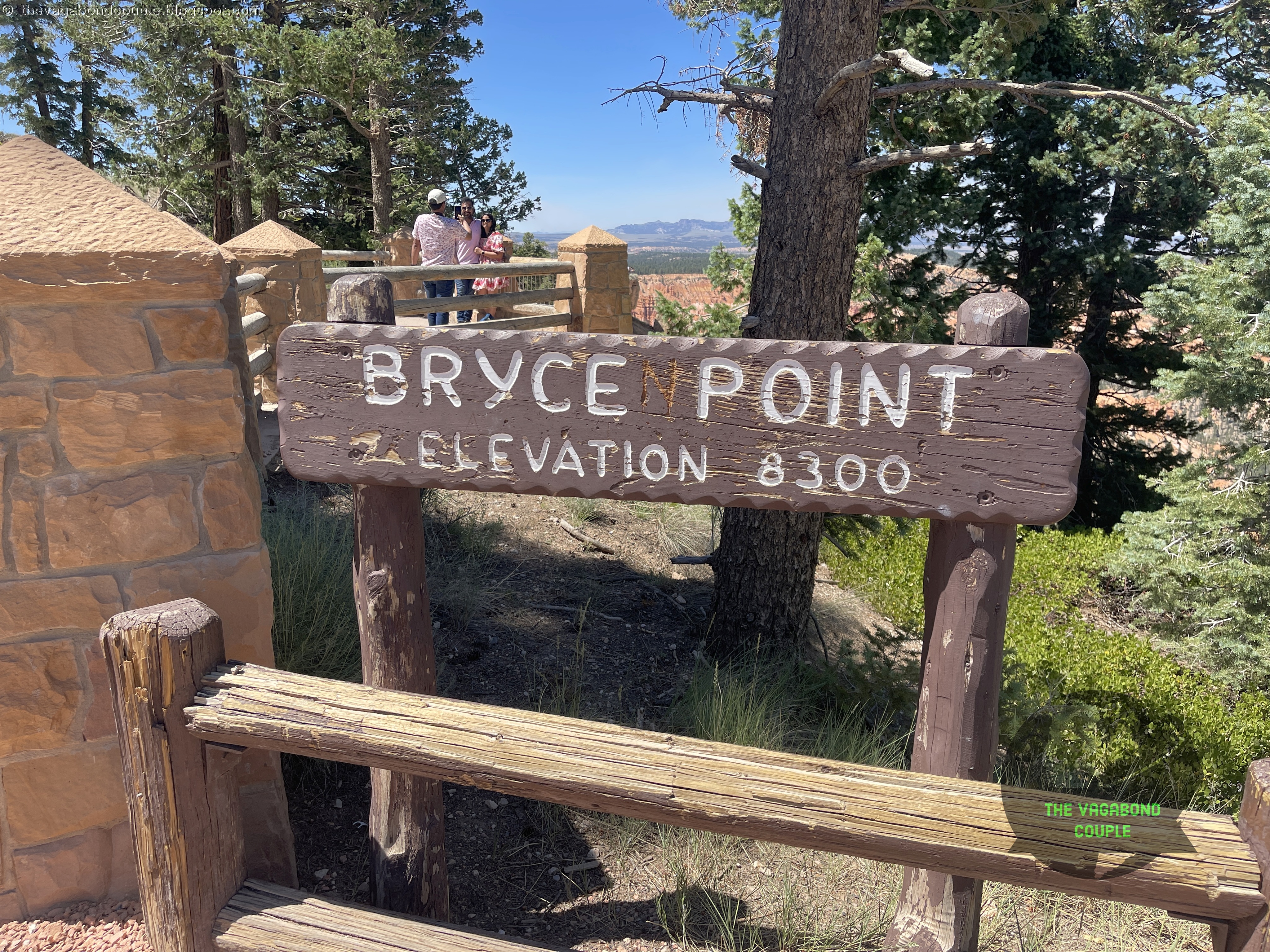 |
| Bryce Point at 8,300 feet. |
The railings at Bryce Point sit above a steep break in the plateau edge. Below them, spires collect in gullies while longer fins mark rock that has not yet separated into individual hoodoos. The view holds several stages of erosion in one frame, a geological production line operating without management meetings.
 |
| Looking across Bryce Amphitheater from Bryce Point. |
The amphitheater continued toward distant forested plateaus. Nothing about it was symmetrical, yet the repeated bands and towers gave the scene a strong order. Erosion had removed enormous quantities of rock and somehow left the leftovers looking organized.
 |
| Bryce Point and its crowded stone skyline. |
Paria View was the quieter final overlook. It faces away from the densest part of the main amphitheater and toward isolated hoodoos, pale cliffs, and forested high ground. The smaller crowd suited the wider spacing of the formations.
 |
| Paria View at the quieter end of our Bryce Canyon drive. |
The distant plateaus also showed how sharply the high country ends. Forest covered the broad upper surfaces, then the edges broke into cliffs and gullies. Bryce Canyon is less a hole than a long retreating margin, with weather steadily moving the boundary westward grain by grain.
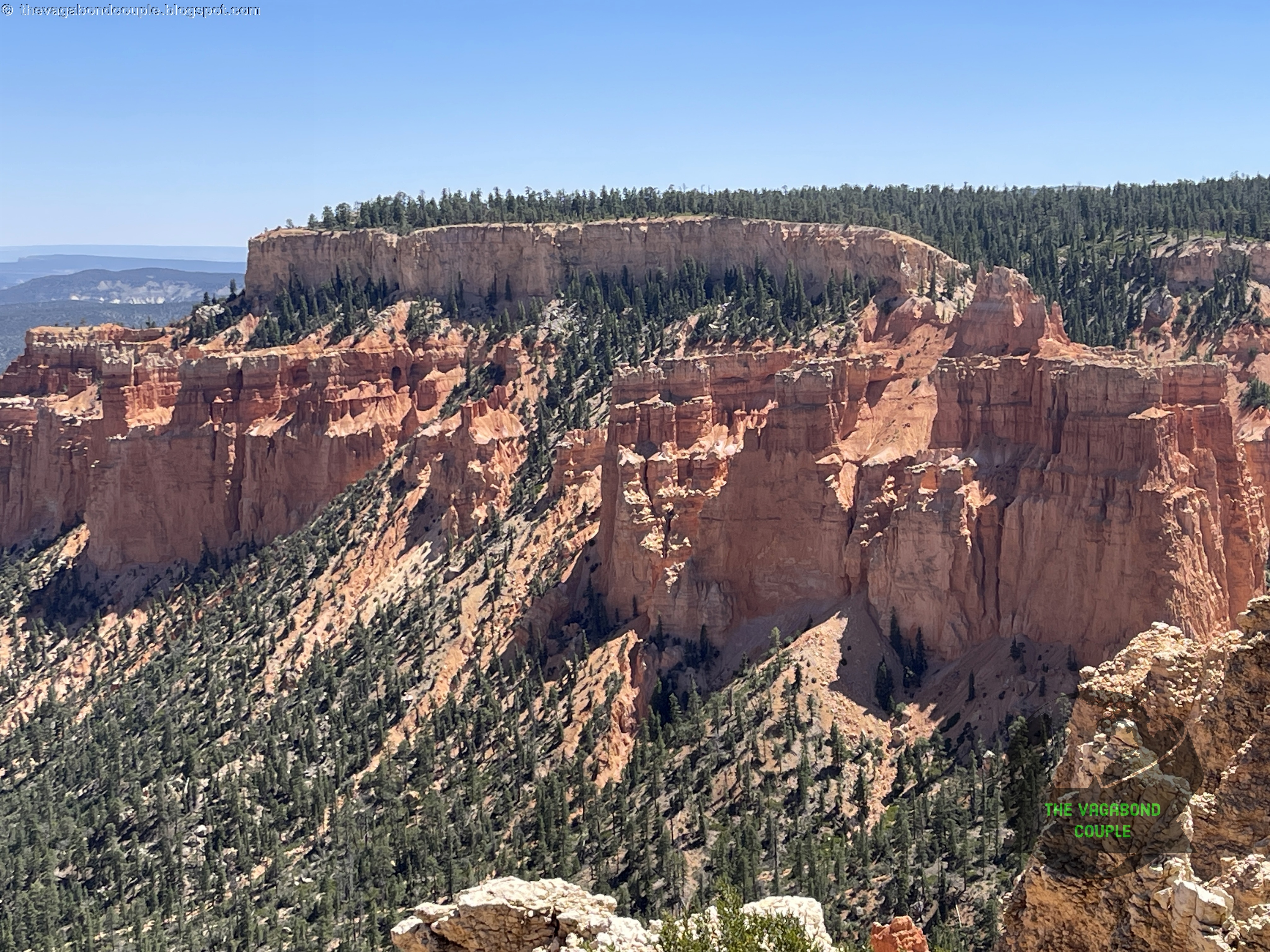 |
| Forested plateaus and pale cliffs beyond Paria View. |
One pale cliff near the viewpoint held natural openings and darker mineral bands. The softer tones were a useful change after the saturated orange near Sunrise and Sunset Points. Bryce had not run out of color; it had merely lowered its voice.
 |
| A weathered pale cliff near Paria View. |
A slender hoodoo stood below the rim, separated from the larger walls around it. Such isolated columns are late-stage survivors. Their caps and harder layers slow erosion for a time, but permanence is not part of the contract.
 |
| A slender hoodoo below Paria View. |
We returned to the visitor-center area for a short break, then pointed Shehzadi south. The Bryce loop had given us highway history, rim overlooks, and a trail below the edge. The next stop replaced vertical rock with mobile sand, because Utah prefers variety and has access to a very large geological warehouse.
 |
| Back at the Bryce Canyon Visitor Center before the southbound run. |
Coral Pink Sand Dunes State Park
We retraced Scenic Byway 12 and US Highway 89, then turned toward Coral Pink Sand Dunes State Park. The entrance road exchanged Bryce's pines and cliffs for open sand backed by wooded ridges. The color came from eroded Navajo Sandstone, ground down and moved until it was fine enough to travel by wind.
 |
| Arrival at Coral Pink Sand Dunes State Park. |
A gap between the Moquith and Moccasin mountains funnels the prevailing wind and increases its speed. Once the air spreads into the wider valley, it slows and drops its load of sand. The process continues today, so the dunes shift while the surrounding mountains remain in charge of the delivery system.
 |
| Walking barefoot across the coral-pink sand. |
We left our shoes behind and climbed. Fine sand absorbs effort with admirable efficiency; every step up becomes a smaller step than the one ordered. The surface was warm, soft, and marked by wind ripples until our footprints arrived to lower the standard.
 |
| On a dune under a very efficient Utah sky. |
Utah established the state park in 1963. About 90 percent of the dune field is open to off-highway vehicles, while a protected conservation area helps preserve sensitive habitat. The split is visible in use: engines work one portion, and hikers spread across quieter slopes elsewhere.
 |
| A quick selfie among the dunes. |
From the higher ridges, the dune field rolled toward juniper and ponderosa pine. The elevation is close to 6,000 feet, high enough for more moisture and plant life than the word dune might suggest. Sand and forest occupied the same view without filing a complaint.
 |
| On a wind-shaped ridge at Coral Pink Sand Dunes. |
The wind had sharpened some crests and rounded others. Each ridge looked fixed until loose grains began running down the lee side. The dunes were moving in the smallest possible units, which made the entire field seem calm while it quietly rearranged itself.
 |
| The open dune field, where every step immediately requested another step. |
The steepest climb ended in the traditional dune bargain: a broad view in exchange for sand in places the manufacturer had never listed as storage compartments. We took the view. The sand came as a mandatory accessory.
 |
| Climbing a steep dune at Coral Pink Sand Dunes State Park. |
The park also protects the Coral Pink Sand Dunes tiger beetle, a species found nowhere else. Its entire known range is tied to this one dune system. A very small insect had managed to become more geographically exclusive than most luxury resorts, while requiring far less marble.
Kanab Sand Caves and the Former Sand Mine
From the dunes, we returned toward Kanab and stopped at the Sand Caves above US Highway 89. The rectangular openings are easy to spot from the road. They look natural from a distance, but the chambers were cut by a short-lived 1970s mining operation that removed soft sand for glassmaking.
 |
| The rectangular openings of the former sand mine above US Highway 89 near Kanab. |
The mine sits in soft sandstone on a ledge above Three Lakes Canyon. Time and weather had already prepared the material; miners supplied the rooms, openings, and interconnected passages. The name Sand Caves survived, which is much friendlier than Abandoned Industrial Excavation Above a Fast Highway.
 |
| Below the Kanab Sand Caves, with the mined chambers visible in the cliff. |
The approach began across sandy ground and a usually dry drainage. Low brush filled the flat below the cliff. The route then angled onto sloping sandstone, where traction depended on choosing the rougher surface rather than the polished line that looked convenient.
 |
| Crossing sloping sandstone on the approach to the Sand Caves. |
The final climb required hands as well as feet. It was short, exposed, and steeper than the view from the parking area suggested. Sandstone has a useful habit of looking comfortably grippy until it has been dusted with loose sand, at which point it becomes a geology-themed practical joke.
 |
| The final sandstone scramble toward the former mine chambers. |
Shehzadi waited below the cliff beside US Highway 89. From the ledge, the highway and canyon floor stretched beneath the openings. The mine had been placed here partly because the soft rock was accessible, and the modern hiking line follows that industrial convenience.
 |
| Shehzadi below the cliffs near the Sand Caves trail. |
Inside, diagonal bedding recorded ancient wind-blown dunes long before the miners arrived. Modern graffiti occupied some of the same walls, a much younger layer with less scientific value and considerably more confidence. The chambers were cool and sandy, with daylight entering through the broad cut openings.
 |
| Cross-bedded sandstone and carved graffiti inside the former mine. |
The connected rooms framed the road and the opposite cliffs like a row of windows. Natural erosion shaped the stone before and after the mine, but the large cavities themselves were human work. The correction made the place more interesting, not less. Utah had supplied the rock; a failed glass-sand venture had supplied the floor plan.
 |
| The man-made Sand Caves openings cut across the ledge above US Highway 89. |
Zion-Mount Carmel Highway to Hurricane
We turned north on US Highway 89, then west onto Utah State Route 9 for the Zion-Mount Carmel Highway. The 25-mile road was built from 1927 to 1930 to connect Zion with Bryce Canyon and the North Rim of the Grand Canyon. Its switchbacks climb through sandstone country before the road enters the mountain itself.
 |
| Shehzadi beside the Zion-Mount Carmel Highway beneath the sandstone cliffs. |
The Zion-Mount Carmel Tunnel runs for 1.1 miles through the cliff. During construction, crews blasted gallery windows for light, ventilation, and disposal of excavated rock. The highway opened in July 1930 and turned a difficult east-west barrier into part of the old Grand Circle motor route. Inside the tunnel, daylight appeared briefly at the galleries, then vanished behind us. Outside, the road dropped through switchbacks toward Hurricane Valley.
Hurricane Lunch and Mexican Revolution Posters
 |
| A metal cowboy in Hurricane, apparently still waiting for a horse with parking sensors. |
Hurricane arrived with a metal cowboy and a name that sounds misplaced in southern Utah. Local tradition says Erastus Snow named Hurricane Hill after a whirlwind blew the top from his buggy in the 1860s. Residents pronounce the town “Her-ah-kun,” a small oral checkpoint separating local speech from weather-channel English.
We stopped for lunch at Las Lupitas Mexican Grill. The walls carried Mexican Revolution portraits and reproductions, including a reward notice that deserved a closer reading. It had no demonstrated connection to Hurricane; it was restaurant décor with a much larger historical address.
 |
| A framed reproduction of a March 9, 1916 reward notice offering $5,000 for Francisco “Pancho” Villa and $1,000 for each of four named associates, displayed at Las Lupitas. |
The March 9, 1916 proclamation offered $5,000 for Francisco “Pancho” Villa and $1,000 for Candelario Cervantes, Pablo López, Francisco Beltrán, and Martín López. Villa had attacked Columbus, New Mexico, that morning. The raid led President Woodrow Wilson to send the Punitive Expedition into Mexico under General John J. Pershing, a campaign that failed to capture Villa but gave military paperwork a very energetic year.
 |
| A portrait of Emiliano Zapata on the restaurant wall at Las Lupitas. |
A nearby portrait showed Emiliano Zapata, whose struggle centered far south in Morelos. The 1911 Plan of Ayala demanded restoration of village lands and redistribution of large haciendas. No reliable record places Zapata in Hurricane, and none was needed. The poster linked our lunch table to the wider revolution without requiring southern Utah to become an undocumented hideout.
St. George Overnight and Shehzadi's 9,441-Mile Odometer
We finished the day at St. George Inn & Suites. St. George grew from the 1861 Cotton Mission, when hundreds of Latter-day Saint families were sent to southwestern Utah to raise cotton and reduce dependence on eastern suppliers during the Civil War. The experiment struggled against heat, floods, and limited water. The heat remained on duty when we arrived.
 |
| St. George Inn and Suites, our overnight stop after a long southern Utah day. |
Shehzadi showed 113 degrees Fahrenheit outside. That was the truck’s dashboard reading, not an official weather-station measurement, but it matched the air waiting in the parking lot. St. George regularly reaches triple digits in summer, and the city’s palms and red cliffs made the hotel look less like a stop near the end of a long Utah day and more like a negotiation with an oven.
The odometer stood at 9,441 miles, up from 9,163 that morning. Part 7 had covered 278 miles from Kanab to Bryce Canyon, back through the dunes and Sand Caves, across Zion, and on to St. George. Since the expedition began at 6,395 miles, Shehzadi had carried us 3,046 miles from the starting reading. The arithmetic was simple. Removing the sand from the cab would take longer.
 |
| Shehzadi's dashboard in St. George: 113 degrees outside and 9,441 miles on the odometer. |
Red Canyon had supplied century-old road portals. Bryce had supplied a trail through hoodoos. The Sand Caves had turned out to be a mine, and Zion had put a highway through a mountain. Millions of years of erosion and a few decades of determined engineering had spent the day sharing the same route. Shehzadi simply connected the evidence.
Next Stop
The next chapter returns from St. George through Hurricane for a fuller day in Zion National Park, following the Virgin River corridor to Riverside Walk and the approach toward the Narrows. Part 7 had crossed Zion as a road. Part 8 would finally get out of the truck and let the canyon make its own case.
Reference route map of our USA and Mexico overland roundtrip: Map-1 and Map-2.
— The Vagabond Couple & Shehzadi
