
.jpg "Grosvenor Arch in Grand Staircase-Escalante") |
| Grosvenor Arch opening twice through pale sandstone above the Cottonwood Canyon country |
Part 5 kept us around Moab for Arches, Dead Horse Point, Canyonlands Island in the Sky and Sand Flats. Part 6 finally pointed Shehzadi west, across the San Rafael Swell and then south toward Kanab.
The route mixed interstate engineering, tilted rock, historic road tunnels and an unpaved run through Grand Staircase-Escalante. It also produced a roadside wave from fellow Maryland travelers, because home occasionally follows us in a van.
Trans-America Overland Part 6 — Post Summary
From Moab, we cross the San Rafael Swell on I-70, turn south for Red Canyon and its historic Highway 12 tunnels, continue through Kodachrome Basin and follow Cottonwood Canyon Road to Grosvenor Arch before reaching Kanab.
| What's Covered | |
| 🛣️ | Moab to San Rafael Reef — Maryland van encounter, tilted strata and I-70 engineering |
| 🐉 | Black Dragon Canyon and I-70 viewpoints — Chimney Rock, Ghost Rock, Sand Bench and Salt Wash |
| 🚇 | Red Canyon — Claron Formation hoodoos and two historic Highway 12 tunnels |
| 🪨 | Kodachrome Basin State Park — colored strata and unusual sedimentary pipes |
| 🏜️ | Cottonwood Canyon Road and Grosvenor Arch — unpaved road and a rare double arch |
| 🍽️ | Kanab overnight — dinner, dashboard reading and the handoff to Part 7 |
We left Moab on I-70 and aimed for Kanab by way of the San Rafael Swell, US-89, Highway 12, Kodachrome Basin and Cottonwood Canyon Road. The mileage was serious. The route’s habit of placing another pullout just beyond the last pullout was even more serious.
Route: Moab to Kanab, Utah
Vehicle: Shehzadi, our Toyota Tundra
Main roads: I-70, US-89, Utah Highway 12 and Cottonwood Canyon Road
Main stops: San Rafael Swell viewpoints, Red Canyon, Kodachrome Basin and Grosvenor Arch
Route character: Interstate rock cuts, hoodoos, historic road tunnels and changing paved-to-unpaved surfaces
Route at a Glance
- Leave Moab and follow I-70 west to the San Rafael Reef.
- Cross the San Rafael Swell through Black Dragon Canyon and the I-70 view areas.
- Turn south on US-89, then take Highway 12 into Red Canyon.
- Continue to Kodachrome Basin State Park.
- Follow Cottonwood Canyon Road to Grosvenor Arch.
- Return to the highway and finish the drive in Kanab.
Moab to the San Rafael Reef
Leaving Moab, we fell in behind a van carrying Maryland plates and a large “Senior Road Trip — Maryland to California” sign. We honked and waved. The occupants answered with equal enthusiasm. No summit, arch or canyon was involved, but the exchange made a fine first landmark.
 |
| A Maryland-to-California road-trip van leaving Moab ahead of us |
Westbound I-70 soon met the San Rafael Swell. The Swell is a broad, asymmetrical anticline raised during the Laramide mountain-building event, roughly 70 to 40 million years ago. Its steep eastern limb forms the San Rafael Reef, where tilted beds rise like a stone barricade beside the interstate.
 |
| Tilted sandstone beds forming the steep eastern edge of the San Rafael Swell |
The beds were deposited long before the uplift. Later regional rise and erosion stripped away overlying material and exposed the fold. From Shehzadi, the geology arrived as alternating red, cream and gray layers pitched at angles no sensible road engineer would request on the original paperwork.
 |
| Red and pale layers leaning sharply along the San Rafael Reef |
At the view area, the interpretive panel turned the banded wall into a readable cross-section. Harder beds held their shape as cliffs and narrow benches, while softer formations weathered into recessed slopes. That contrast in rock strength explains the reef’s serrated profile. The sign did not make the geology simple; it merely gave the organized disorder proper names.
 |
| The interpretive panel at the San Rafael Reef view area beside I-70 |
I-70 changed the practical meaning of the barrier. A 70-mile section through the Swell opened in 1970 as an initially two-lane road. At Spotted Wolf Canyon, construction crews enlarged a natural passage that had been too narrow for a modern interstate. The result looks inevitable only after somebody else has completed the blasting.
 |
| Westbound I-70 entering a rock cut through the San Rafael Reef |
Beyond the engineered cut, the reef returned to its untrimmed profile. The road cut exposed the tilted beds from the side, almost like a slice through a layer cake that had lost an argument with gravity. From the next pullout, those same beds resumed their full height, restoring the scale that highway excavation had briefly compressed.
 |
| Steep reef cliffs seen from an I-70 pullout in the San Rafael Swell |
I-70 View Areas Across the San Rafael Swell
The westbound route then threaded a sequence of canyon walls, isolated formations and signed viewpoints. We saw these places from I-70 and its pullouts. We did not turn every name on the map into a canyon hike, which would have required a second day and a more negotiable relationship with time.
 |
| Dark canyon walls beside the interstate near Black Dragon Canyon |
Black Dragon Canyon is associated with a rock-art panel that includes older Barrier Canyon-style painted figures and nearby Fremont petroglyphs. Later chalking joined several separate images into a dragon-like outline. The modern name grew from that altered composite, not from one original Fremont painting of a dragon. An older online interpretation describes a single dragon, but the panel preserves several images from more than one cultural period.
 |
| I-70 bending through layered rock in Black Dragon Canyon country |
Farther west, the steep eastern beds began giving way to the Swell’s broader interior, where erosion left open benches, cliffs and isolated towers. Chimney Rock appeared within that change, first as a narrow profile and then as a broader sandstone remnant. Its position above the road supplied enough drama without extra stage directions.
 |
| Chimney Rock rising above the broken terrain of the San Rafael Swell |
From the first angle, Chimney Rock looked almost detached from everything behind it. As Shehzadi moved west, the profile widened and revealed more of the rock mass connected to the tower. The change was simple parallax, but it made the same formation look like two separate designs filed under the same address.
 |
| Chimney Rock standing beside the I-70 corridor |
The second view placed Chimney Rock within the road corridor rather than alone against the sky. The interstate’s alignment made the formation a temporary landmark: it appeared, broadened and then fell behind within minutes. That fleeting sequence explained why roadside geology benefits from photographs. The windshield supplied only a few seconds before the next curve edited the composition.
 |
| I-70 and layered cliffs below the Chimney Rock View Area |
From the overlook, the Swell no longer resembled a smooth arch. Erosion had breached the crest, stripped away upper layers and cut terraced canyons into the remaining structure. The highway crossed that broken interior by linking natural openings with engineered cuts. It was efficient transportation through a geologic feature that had never volunteered to become convenient.
 |
| A broad view across the San Rafael Swell from Chimney Rock View Area |
The “Outlaw Country” panel placed the pullout within the wider history of the Swell. Livestock grazing, uranium mining, and oil and gas work later brought people into country that still had long stretches with few roads. The panel added outlaw stories to that regional record. We treated those stories as interpretation, not as proof that every famous bandit had signed the guest book.
 |
| The Outlaw Country interpretive panel at Chimney Rock View Area |
Roadside names also make enormous country easier to remember. A pale monolith becomes Ghost Rock; a narrow pillar becomes Chimney Rock; the map gains landmarks instead of anonymous miles. On our paper map and through the windshield, conspicuous formations served as practical waypoints. The names may be fanciful, but the navigational habit behind them is thoroughly sensible.
 |
| Ghost Rock above a passing tractor-trailer on Interstate 70 |
The tractor-trailer gave Ghost Rock an immediate measure of scale. Without the truck in the second view, the formation seemed smaller at first, even though nothing had moved except us. That visual trick is common in open desert country, where distance removes familiar reference points and a cliff can masquerade as a modest roadside lump.
 |
| Ghost Rock and surrounding cliffs from the roadside view area |
Sand Bench View Area lived up to its actual name rather than behaving like a beach. In geology, a bench is a relatively level step controlled by a resistant rock layer, often set between steeper slopes. The overlook displayed several such steps across the cliffs. Utah had supplied plenty of sand, but the ocean had declined the invitation.
 |
| Layered cliffs and benches from Sand Bench View Area |
Salt Wash exposed another part of the regional record. The Salt Wash Member of the Morrison Formation represents braided-stream channels, abandoned channels and floodplains, not a marine seabed. Water still explains the deposits, but it arrived by rivers spreading sediment across low ground rather than by an ocean parking offshore.
 |
| Salt Wash and its layered terrain from the I-70 overlook |
The settlement panel at the overlook described the 1877 call to establish communities in Castle Valley, between the Wasatch Plateau and the San Rafael Swell. The panel emphasized the practical difficulty of establishing communities in harsh country. Distance, dry ground and limited water made the title feel less like marketing and more like a warning label.
 |
| The “A Place Nobody Wanted” settlement-history panel at Salt Wash View Area |
Smoke Along the Route
Near the I-70 and US-89 corridor, a dark plume rose above distant mountains. From a moving highway, the line of sight compressed distance and gave us no reliable way to identify the source. We could confirm smoke, its general direction and little else. Assigning a fire name from that evidence would have required binoculars, official reports and a much less ambitious imagination.
 |
| A distant smoke plume above mountains near the I-70 and US-89 corridor |
The sight recalled the smoke we had seen on the Colorado Springs-to-Moab leg through Glenwood Canyon. That earlier plume had also remained unidentified from the road, so we applied the same restraint here. We kept moving, left I-70 and turned south on US-89, carrying two photographs of smoke and exactly zero qualifications in smoke-source investigation.
Red Canyon and the Highway 12 Tunnels
From US-89, we detoured onto Utah Highway 12 and entered Red Canyon in Dixie National Forest. Hoodoos and spires rose among ponderosa pines, built mainly from orange-red Claron Formation rock comparable to formations at nearby Bryce Canyon. The road changed quickly from broad highway to a narrow corridor where rock, trees and pavement competed for the same limited space.
 |
| The west entrance to Red Canyon beside Utah Highway 12 |
Past the entrance sign, the road entered a tight corridor of red spires and ponderosa pines. The trees were more than green decoration against orange rock. The nearby Red Canyon Research Natural Area preserves dry woodland, shrubland and conifer communities growing on contrasting geologic substrates. The canyon therefore changes not only in shape and color, but also in the plant communities its soils can support.
 |
| Red Canyon hoodoos and ponderosa pines beside Highway 12 |
The road soon passed through the first of two historic openings cut through red rock for Highway 12. By 1925, the pair had been recognized as the original entrance to Utah National Park, the short-lived name used before Bryce Canyon became a national park. Road engineering had acquired ceremonial architecture without commissioning an architect.
 |
| The first historic Highway 12 tunnel through Red Canyon |
The first opening released us into a brief strip of daylight before the second closed around the road. That spacing makes the pair read as a sequence rather than one long bore. Nearly a century after their 1925 recognition, the openings still framed the approach to Bryce country, although modern traffic now asks them to accommodate vehicles considerably wider than a touring car with optimistic brakes.
 |
| The second historic Highway 12 tunnel through Red Canyon |
Seen together, the tunnels framed the highway against the red cliffs and hoodoos. Iron-bearing minerals contribute to the orange and red colors, while erosion shapes the Claron rock into fins, columns and irregular spires. Harder beds protect weaker material for a time; water, frost and gravity keep revising the arrangement. The road structures belong to human history. The hoodoos do not.
Driving through the openings showed the difference clearly. A natural arch develops as rock is removed by geological processes. These tunnels were cut so vehicles could pass through the ridge. Both kinds of openings are useful, but only one came with lane markings, reflectors and a maintenance budget.
 |
| Both historic road tunnels framed by the red cliffs of Highway 12 |
Video: driving both directions through Red Canyon and its two historic Highway 12 tunnels
Kodachrome Basin State Park
Highway 12 led us toward the Grand Staircase country. The “staircase” is a broad south-to-north succession of cliffs and plateaus: Chocolate, Vermilion, White, Gray and Pink Cliffs. We crossed only part of that sequence, but the stacked colors made the name less metaphorical than it first sounded.
 |
| The Grand Staircase-Escalante interpretive panel near Kodachrome Basin |
Kodachrome Basin State Park sits within this layered setting. A National Geographic Society expedition named the area Kodachrome in 1949, with Kodak’s consent, after the film known for saturated color. The basin has retained the name despite cameras spending the next several decades becoming telephones.
 |
| The entrance to Kodachrome Basin State Park |
Inside the park, the basin opened into a broad floor ringed by striped cliffs and isolated upright forms. The open center made the sedimentary pipes easier to distinguish from ordinary ridges because they rose across the basin rather than following the horizontal bedding. The terrain looked spacious until a pipe supplied scale and reminded us that spaciousness is mostly a matter of insufficient measuring equipment.
 |
| A wide view of Kodachrome Basin’s cliffs, spires and open floor |
The park contains about 67 sedimentary pipes. Their complete origin remains debated. Utah Geological Survey work describes at least some as Carmel Formation sediment intruded into overlying Entrada Sandstone, while park material preserves several formation hypotheses. Certainty would be convenient, but the rocks have declined to issue minutes from the meeting.
 |
| A sedimentary pipe rising above the floor of Kodachrome Basin |
We followed the park roads among red, cream and pale cliffs. The same sequence looked different as sun angle, distance and road direction changed, which kept the photographs from becoming copies even when the subject remained the basin. A broad view showed color bands; a closer bend exposed ledges and recesses. The road kept rearranging the evidence without changing the rock.
 |
| The park road winding between pale and red cliffs |
Farther along, the maintained park road gave way to a rougher surface and the surrounding cliffs drew back from the track. The change marked a practical transition from the compact state-park loop toward the wider Cottonwood Canyon corridor. Shehzadi had already spent the morning on interstate pavement; dirt and gravel now restored the expedition’s preferred level of administrative uncertainty.
 |
| An unpaved road crossing open ground near Kodachrome Basin |
Cottonwood Canyon Road, marked on our map as Rt. 7000, begins with paved access near Kodachrome and continues as an unpaved backcountry road. The surface changed gradually rather than at one theatrical boundary. Some miles remained straightforward dirt and gravel; others required slower steering around ruts and loose edges. Conditions vary with weather, so our experience describes that drive, not a permanent road guarantee.
 |
| Cottonwood Canyon Road passing layered southern Utah cliffs |
The road then exposed wider cliff bands above the basin. From the moving truck, the change in angle made individual beds easier to follow across the rock face, showing that the stripes continued far beyond a single photograph. Cottonwood Canyon Road functioned as a long geologic transect, although it charged no tuition and offered very limited parking for the final examination.
 |
| Broad banded cliffs above Kodachrome Basin |
Wide bands of red, cream and white crossed the cliffs. Iron oxides helped produce the warmer tones, while paler beds reflected different minerals, cement and chemical histories. Color alone did not turn each stripe into a separate formation, but it made the bedding easier to read from the road. The chemistry had done the work without hiring adjectives to supervise.
 |
| Red and cream sedimentary layers exposed in Kodachrome Basin |
At the next exposure, the red beds and pale layers came into sharper contrast. The closer view showed that Kodachrome’s color is organized in bands rather than spread evenly across every surface. Permanent mineral color remained visible where shadow changed, allowing us to separate the rock’s own tones from the temporary lighting supplied by the afternoon sun.
 |
| Iron-rich red sandstone beside paler rock layers |
The following cliff shifted toward cream and white bands above the red rock. The paler face reflected more light, making ledges and recesses easier to distinguish from the road. What had looked like a smooth wall at distance resolved into stacked surfaces, shallow alcoves and debris aprons. The road bend changed the geometry as much as the palette.
 |
| Pale cliff bands rising above red rock in Kodachrome Basin |
Another isolated pipe rose among the cliffs before the road opened toward Cottonwood Canyon. Its vertical shape interrupted the ordinary horizontal bedding, which helps explain why geologists have examined intrusive formation models for at least some pipes. The column looked less like a conventional outcrop and more like the geology department had pushed one exhibit through the floor of another.
 |
| An isolated sedimentary pipe among the basin’s cliffs |
Cottonwood Canyon Road to Grosvenor Arch
Once fully on Cottonwood Canyon Road, the route narrowed to dirt and gravel, and the steering became the day’s main task. Shehzadi handled the loose surface and broad bends without drama. We were on a backcountry road, not a technical four-wheel-drive trial; the distinction matters because dust can look heroic in photographs while remaining administratively ordinary.
 |
| Cottonwood Canyon Road descending toward Grosvenor Arch country |
BLM places Grosvenor Arch about 18 miles south of Cannonville: roughly seven paved miles and 10.5 unpaved miles on Cottonwood Canyon Road, followed by a signed one-mile spur to the parking area. A short paved path completed the approach. The long approach created the isolation; the arch itself needed no survival documentary.
 |
| Grosvenor Arch’s twin openings appearing from the approach road |
Grosvenor Arch is a rare double natural arch. The lower support includes Henrieville Sandstone, while Cedar Mountain and lower Dakota rocks occur higher in the feature. The contacts between the layers remain visible across the face. The openings look almost symmetrical from a distance, but the unequal spans and changing rock bands become clearer on approach.
The road and arch also changed the scale of the day. I-70 had crossed the Swell with major cuts and grades. Cottonwood Canyon Road narrowed the experience to dust, gravel and individual cliff bands. At the end, Grosvenor Arch reduced the route again to a short walk and two openings in one wall.
 |
| The double arch rising above desert shrubs |
From the parking area, the paved approach kept the double arch in view while the separate spans gradually resolved from the pale wall. The short walk did not require us to turn the stop into a technical expedition. It required walking shoes, attention and the usual delay caused by taking one more photograph after the previous final photograph.
The arch was named for Gilbert C. Grosvenor, a former president of the National Geographic Society. That connection fitted neatly beside Kodachrome Basin’s own National Geographic naming history. One organization had managed to leave both a film name and a surname on the same route.
 |
| Grosvenor Arch framed by pale sandstone walls |
Moving closer separated the two openings and revealed that they were neither equal in width nor surrounded by a wall of uniform thickness. Bedding lines continued across the face while joints and recessed zones interrupted them. From the parking area the arch looked like a symbol; from the walkway it became a complicated rock structure with two very large absences.
 |
| A closer view of the two openings through Grosvenor Arch |
We followed the paved approach and studied how the openings divided the surviving wall. The larger span carried most of the visual weight, while the smaller opening changed shape as our angle shifted. The silence beneath them needed no portal legend. The rock already connected two sides of a sandstone wall, which was enough portal work for one afternoon.
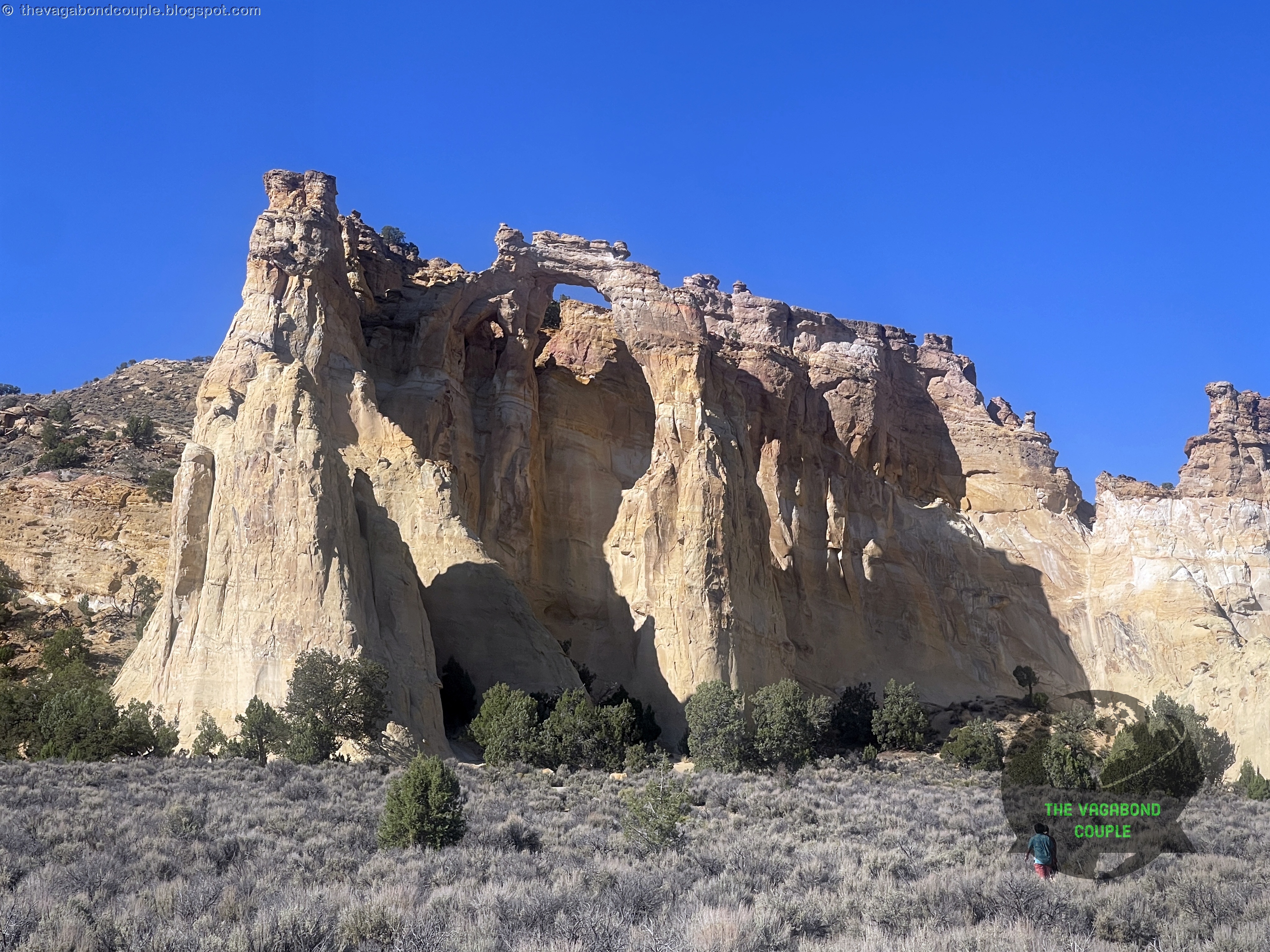 |
| The full face of Grosvenor Arch above the approach path |
From below, Grosvenor Arch became a vertical study in ledges and bedding. The view showed how much rock remained above and between the openings, a detail flattened by distant photographs. Looking upward replaced the tidy double-arch silhouette with overhangs, shadowed recesses and stacked stone. It was less postcard, more engineering drawing prepared by erosion.
 |
| Looking upward beneath the sandstone spans of Grosvenor Arch |
Video: Cottonwood Canyon Road and Grosvenor Arch in Grand Staircase-Escalante
Arrival in Kanab
We retraced the unpaved road, returned to the highway and continued to Kanab. Dinner came at Peekaboo Canyon Wood Fired Kitchen, where the storefront provided the first thoroughly urban geometry since the morning’s interstate. After a day of rock names and geological labels, this name had an immediate practical consequence: food. Dinner had finally acquired a location, a table and considerably fewer sedimentary explanations.
 |
| Peekaboo Canyon Wood Fired Kitchen in Kanab |
We checked into the Days Inn & Suites by Wyndham Kanab. Shehzadi’s dashboard showed 9,163 miles. Against the established departure reading of 6,395 miles, the expedition had added 2,768 miles. The figure included the day’s Red Canyon detour, Kodachrome Basin roads and the run to Grosvenor Arch. That was enough accounting for one night; dinner had already closed the books.
 |
| Shehzadi’s dashboard at the end of the Moab-to-Kanab leg |
This leg compressed several versions of southern Utah into one drive. I-70 cut through the folded beds of the San Rafael Swell. Highway 12 used constructed tunnels among Claron hoodoos. Cottonwood Canyon Road traded pavement for dirt before Grosvenor Arch. Shehzadi carried the sequence from Moab’s Colorado Plateau country to Kanab without requiring the geology to become folklore.
Next Stop: Bryce Canyon, Sand Caves and Coral Pink Sand Dunes
Part 7 begins from Kanab and continues to Bryce Canyon, the Sand Caves, Coral Pink Sand Dunes, Hurricane and St. George. Red Canyon returns as the doorway to Bryce, but the next leg belongs to the hoodoos, sand and southwest Utah towns beyond it.
Reference route map of The Vagabond Couple's USA and Mexico overland roundtrip: Map-1 and Map-2.
